






The short answer: if an ordinary person could recognize a celebrity in an AI advertisement, treat the celebrity’s consent and a written licence as the first requirements to verify. The licence must cover the specific element being used—name, face, voice, image, recording or digital replica—as well as the purpose, product, territory, term, channels and permitted modifications.
The fact that AI creates a new file does not automatically eliminate the rights of the person being imitated. You must also check copyright in the photographs, videos, sound recordings or source materials; the risk that consumers may mistakenly understand the celebrity to have endorsed the product; and any transparency obligations for synthetic content. This is general information and does not replace advice from a lawyer in the jurisdiction where the advertisement is produced, distributed or targeted.
What types of rights can AI advertising implicate?
There is no single “image copyright” that applies in the same way worldwide. The name, scope and duration of each right depend on the law and contracts applicable in each jurisdiction. However, a campaign planner can begin with the following rights map:
| Rights or obligations | What do they protect or control? | Example risk |
|---|---|---|
| Publicity rights or rights to commercially exploit identifying characteristics | A person’s name, face, voice, signature, appearance or other characteristics that enable the public to identify them when used for commercial purposes, depending on the applicable law. | Creating a presenter whose voice and manner of speaking lead viewers to believe that the real performer is introducing the product. |
| Copyright | Photographs, videos, sound recordings, songs, scripts, designs or other works used in the advertisement or as input data. | Using an interview excerpt, song or press photograph to create commercial content without permission to reproduce, adapt or exploit it. |
| Performers’ rights and related rights | Performances, sound recordings, audiovisual recordings and the rights of phonogram producers, depending on the legal system. | Obtaining permission from the singer but not from the owner of the recording used to create the voice replica. |
| Trademarks and commercial identifiers | A stage name, logo, slogan or other sign that makes the public associate the person or brand with the advertisement. | Using an artist’s name or an associated symbol in a way that creates the impression of an official partnership. |
| Advertising and consumer-protection law | The truthfulness and substantiation of claims, and disclosure of the commercial relationship. | Having a voice replica say, “I use this product,” when the celebrity has never used the product or said those words. |
The U.S. Copyright Office describes a “digital replica” as potentially including an image, sound or video that simulates an individual; the report also discusses how rules against deceptive advertising may apply when a digital replica misleads consumers or exploits a person’s reputation (according to copyright.gov). This is a U.S. example, not an automatic conclusion applicable in every country.
When should you treat a licence as mandatory?
Treat a licence as necessary if an ordinary person could recognize the celebrity and the content is used to advertise, sell products, solicit subscriptions or create the impression of an endorsement.
- Using the person’s actual image, name or voice: identify who has authority to grant permission and whether that authority covers the advertising purpose.
- Using an AI-generated replica: separately verify the rights to create, store, modify, distribute and reuse the replica; do not assume they follow from an ordinary image licence.
- Imitating the person without naming them: is not always safe. If the public can still readily identify a specific person, risks involving publicity rights or misleading advertising may remain.
- Using the image of a deceased person: check laws governing post-mortem rights, heirs or estate-management organizations. The duration and conditions of protection may differ.
- Use in news reporting, criticism or artistic works: may qualify for an exception in some jurisdictions, but do not automatically extend an expressive-use exception to advertising a product for sale.
California’s civil jury instructions describe claims involving the knowing use of another person’s name, voice, signature, photograph or likeness for commercial purposes. This is an example under California law, not a universal rule (according to courts.ca.gov).
What should an AI licence specify?
A statement such as “permission to use the image” is usually too narrow to govern an AI campaign. Prepare a comparison table before signing:
| Item to specify | Practical question |
|---|---|
| Covered subject matter | Does the licence cover the name, stage name, face, voice, singing voice, gestures, signature, image data and recordings involved? |
| AI activities | Are sampling, analysis, training, replica creation, text-to-speech, lip-syncing, face replacement, editing or the creation of new variations permitted? |
| Purpose and product | Is use limited to a particular campaign or product? May the material be reused for another brand? |
| Channels and territories | Will it run on social media, television, a website, an e-commerce platform or outdoor advertising? In which countries or regions? |
| Term and retention | Until what date may it be used? May it be rerun, translated into other languages or retained as a template after the campaign ends? |
| Approval | Who approves the script, voice-over, final visuals, translations and the context in which they appear? |
| Content restrictions | Are any sectors prohibited or subject to separate approval, such as medicines, dietary supplements, financial services, politics, gambling or content directed at children? |
| Rights sublicensing | May the brand grant rights to an agency, advertising platform, production company or AI provider? |
| Termination and deletion | Upon termination, who will stop distribution, remove copies, delete source materials and handle versions that remain on advertising platforms? |
| Liability | Who is responsible if the content exceeds the authorized scope, makes a false claim or is challenged by a third party? |
Minimum record template: “Licensed asset: [mô tả]. AI activity: [tạo/chỉnh sửa/bản sao giọng nói]. Product and campaign: [tên]. Channels: [danh sách]. Territory: [danh sách]. Term: [ngày bắt đầu–ngày kết thúc]. Approver: [tên/chức danh].” This is a review framework, not a complete contract template.
How can a voice replica create a fake endorsement?
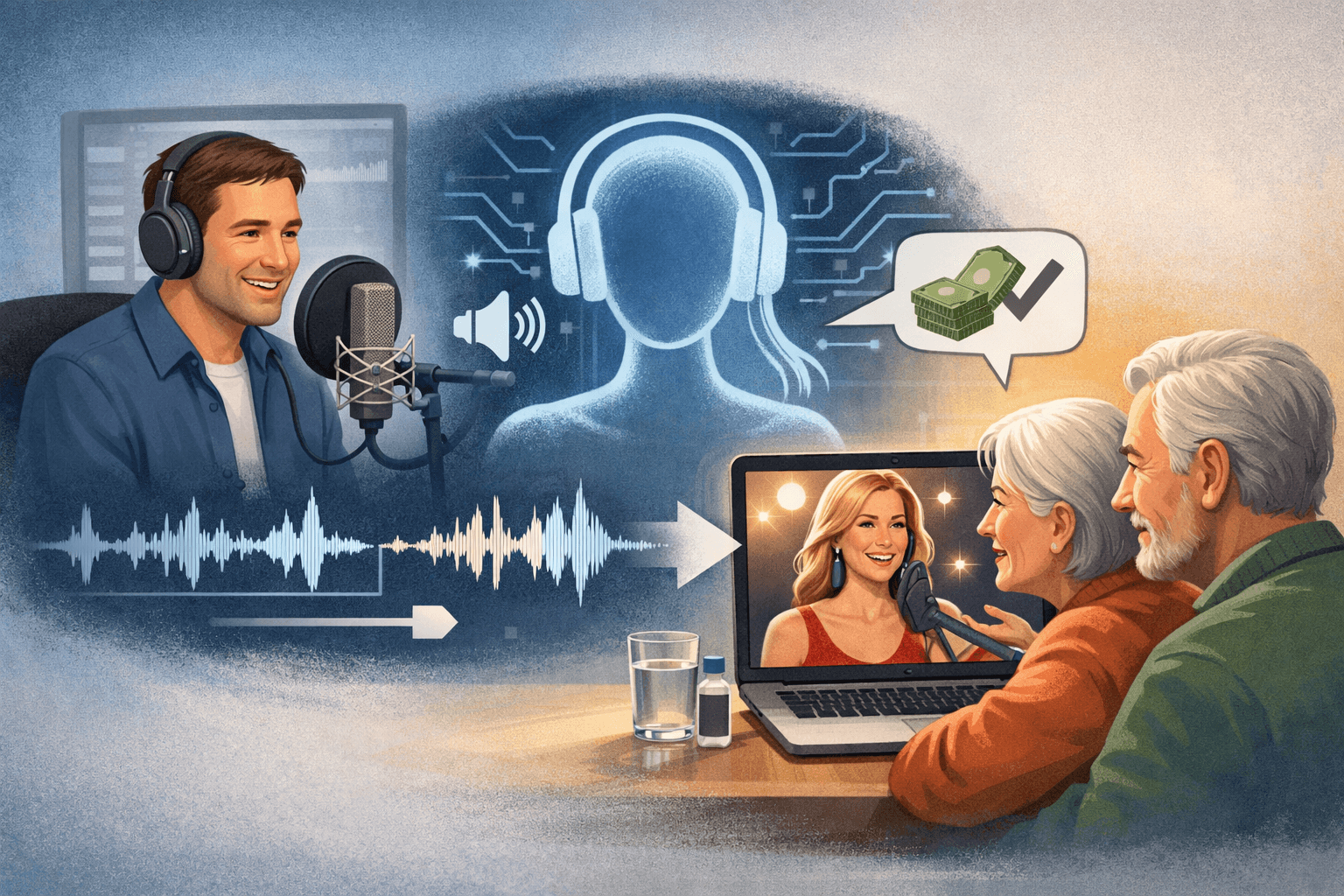
The main risk is not merely that the voice “sounds similar.” The issue is that the advertisement may lead viewers to believe that the celebrity said something, used the product or recommends it.
Hypothetical example: a company uses a voice replica of Singer A to read the line, “I drink this product every day and feel healthier.” If A has never used the product, never said those words or never authorized a simulated endorsement, the advertisement could be misleading even if the company holds a general license to use the voice.
U.S. Federal Trade Commission (FTC) guidance states that a celebrity endorsement must reflect the person’s honest experience or opinion; if an advertisement represents that a celebrity used a product, the celebrity must actually have used it. The guidance also describes a situation in which using a celebrity’s likeness to speak positively about a product without permission could lead consumers to understand that the person endorsed it (see ftc.gov).
Accordingly, classify the script before production:
- Fictional character: clearly identify the character as synthetic and do not present personal experiences as real.
- Endorsement: use it only when the celebrity has actually had a relevant experience, the content has been approved and supporting records have been retained.
- Hired voice-over: permission to use a voice does not automatically mean that the person endorses every claim in the advertisement.
Can an AI label replace a license?
No. Labeling content as AI-generated and obtaining permission are separate matters. A label does not eliminate rights in identifying characteristics, copyright or liability for misleading advertising; conversely, a license does not always remove transparency obligations.
In the European Union, Article 50 of the Artificial Intelligence Act sets out certain disclosure obligations for image, audio or video content generated or manipulated using AI, including content that constitutes a deepfake. The provision also specifies how the disclosure must be made and provides certain exceptions for artistic, creative, satirical or fictional works (see eur-lex.europa.eu). Its specific application depends on the roles of the parties involved, the timing and the relevant market scope.
If the content will be released in multiple countries, check the requirements of each market and platform. A clear label could read: “The images and voice in this video were generated or manipulated using AI.” Do not place the label where it is difficult to see or use vague wording to conceal the synthetic nature of the content.
Pre-release review process
- Map identifying features: list the face, voice, name, stage name, songs, catchphrases, manner of walking, hairstyle, clothing and distinctive settings.
- Identify the licensor: this may be the person themself, a management company, record label, producer, heir, estate-management organization or sound-recording owner.
- Read the contract right by right: look for provisions concerning voice, digital replicas, synthetic media, AI, training, derivative works, sublicensing and advertising—not only the phrase “image rights.”
- Check the source materials: verify the rights to the photographs, videos, recordings, songs, scripts and voice data. Record the source and corresponding license for each item.
- Review the claims: flag first-person statements, claims that the person has used the product, efficacy claims and content presented as expert advice.
- Check the markets: list every place where the advertisement may be viewed, not only where the company is headquartered.
- Design the label: decide the content, placement, duration, size and language; check each channel’s final creative.
- Keep records: retain contracts, addenda, approvals, data sources, content-generation logs, final creatives and the list of platforms.
- Legal review: obtain a review for the relevant market, especially for advertising related to health, finance, politics, children or deceased people.
Review the creative once from a consumer’s perspective: “Would I think this celebrity actually said this, used the product or endorsed it?” If the answer is yes but the records cannot substantiate that impression, stop publication and revise the script or the scope of the rights.
If you are reviewing a video or audio clip that appears to feature a celebrity speaking, you can also see how to check for manipulated video and voice content. Detecting manipulated content does not replace the permission process when you are the party creating the advertisement.
Assumptions that can create risk
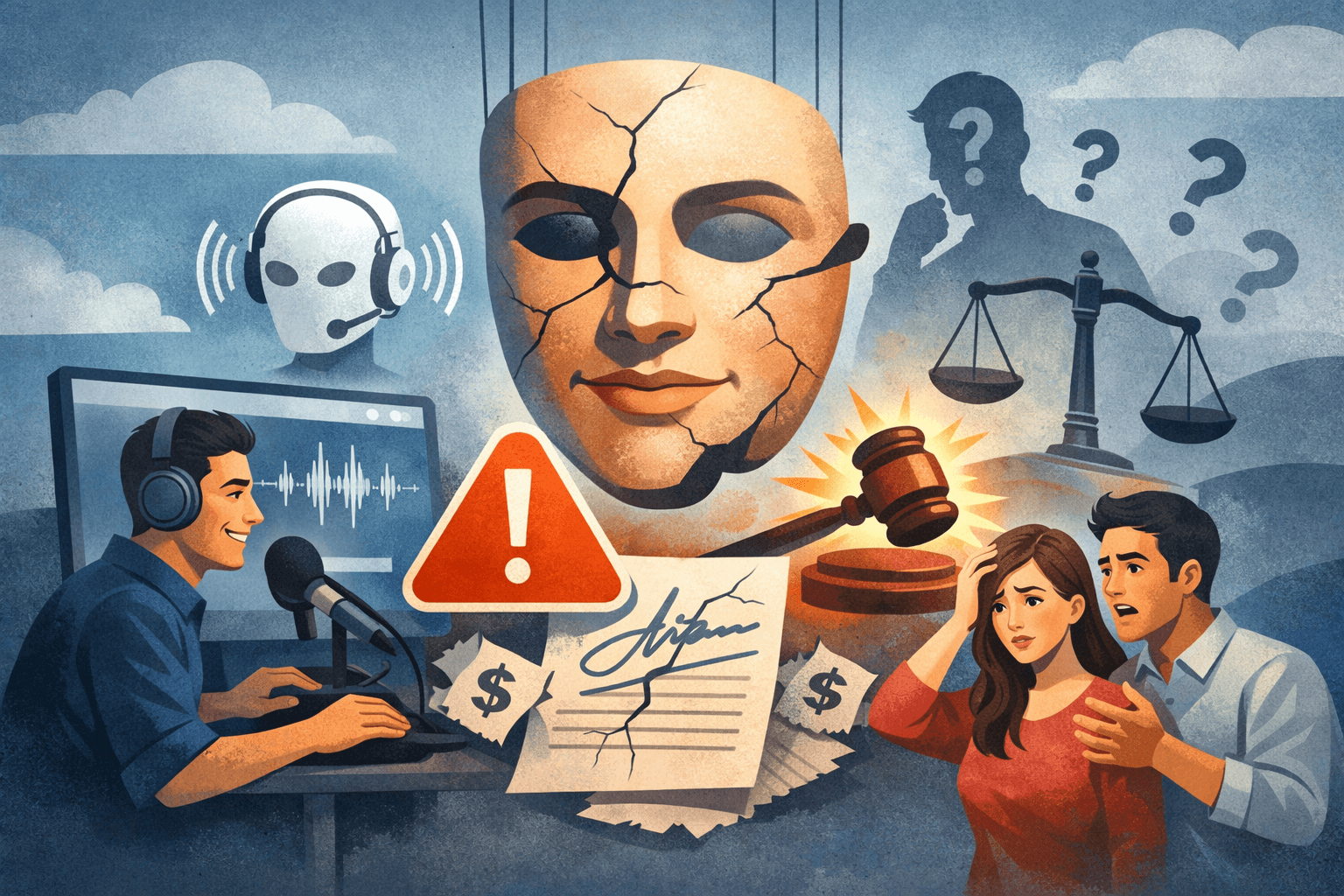
- “I only used a descriptive prompt, not a real photograph.” If the result still leads the public to recognize a specific person and is used to sell something, the risk has not disappeared.
- “It is clearly labeled as AI, so permission is not needed.” A transparency label does not automatically eliminate rights in a person’s identity, copyright obligations or advertising liability.
- “The image is on the Internet, so it can be used.” Public availability does not necessarily mean you have the right to copy, modify or commercially exploit the material.
- “The celebrity gave permission, so any related material can be used.” The person may not own the copyright in photographs, recordings or footage produced by someone else.
- “It is only an internal test.” If it has been shared with customers, partners, investors or an external user group, calling it internal may not eliminate the risk.
- “It will be used only once.” An advertisement may continue to exist in an ad library, reposts, translations or shortened versions.
What to do if the rights file is incomplete: stop and remediate
Before publication, the absence of any essential right is a reason to switch to a creative that does not identify a specific person, obtain the missing permission or stop the campaign. If the advertisement has already been published:
- Pause distribution and paid advertising.
- Remove the unauthorized creative from internal libraries, advertising platforms and public channels to the extent you control them.
- Notify agencies, technology partners and distributors of the scope of the suspension.
- Preserve evidence of the version, publication time and data sources; do not delete records needed for the review.
- Republish only after the rights, script or transparency labeling has been revised and received fresh approval.
Three questions to answer before running the advertisement
- Could the audience recognize someone? If so, list all rights related to that person.
- Could the audience understand that the person said, used or endorsed the product? If so, verify the claim’s accuracy, the person’s consent and the rules governing endorsements and testimonials.
- Does the rights file establish the exact scope of use? If it does not clearly specify the assets, AI activities, purpose, territory, term, channels and sublicensing rights, the advertisement should not yet be released.
The useful question is not “Can AI do this?” but: who has the authority to permit it, how far does that permission extend, and how will viewers understand this advertisement?
Reference source
- Copyright and Artificial Intelligence, Part 1: Digital Replicas — U.S. Copyright Office.
- Advertising FAQ’s: A Guide for Small Business — Federal Trade Commission.
- The Consumer Reviews and Testimonials Rule: Questions and Answers — Federal Trade Commission.
- Judicial Council of California Civil Jury Instructions 2026 — Judicial Council of California.
- Regulation (EU) 2024/1689 of the European Parliament and of the Council of 13 June 2024 — EUR-Lex.
