






If a video, call or message uses a public figure’s image and voice to advertise, solicit investments, ask for money or pressure you to act, do not trust it simply because it looks convincing. Check it on multiple levels: the posting source, context, statements, audio and visual cues, AI labels and provenance information. If the content requests money, an authentication code or sensitive information, the safest first step is to stop and verify it through a channel you find yourself.
This article is for viewers who want to check a specific piece of content, not forensics training. Technical indicators are only supporting evidence; safer conclusions usually come from cross-checking the source, content and purpose of the request.
What is a deepfake, and what do AI labels not prove?
Under the EU legal framework, a deepfake is an AI-generated or AI-manipulated image, audio recording or video that resembles a real person, object, place, organization or event closely enough that it could make viewers believe it is authentic content. Therefore, content using a public figure’s face or voice is not automatically a deepfake; fictional scenes, satire or artistic works may fall into different categories, but they may still need to disclose the presence of artificial content in an appropriate manner (according to eur-lex.europa.eu).
An AI label and the truthfulness of a message are two different things. A video labeled “AI-generated or altered” is not necessarily a scam. Conversely, a video without a label is not necessarily genuine: the uploader may not have disclosed it, the platform may not yet display a label, or provenance information may have been lost when the content was reposted.
A six-step process for checking fake videos and voices
1. Stop when the content pressures you to act
Pause if the content makes you panic, feel excited or fear missing an opportunity. Warning signs include “today only,” requests for secrecy, demands for immediate payment, requests for authentication codes, instructions to buy cryptocurrency or claims of returns with virtually no risk.
These are not technical evidence that the video is a deepfake. However, they are strong enough reasons for you to not click links, send money or provide personal information until you have verified it independently. The Federal Trade Commission (FTC) warns that scammers may use altered video or audio to create fake celebrity endorsements; it advises consumers to search for the public figure’s name, the product name and terms such as “scam” or “fake” before buying or investing (according to consumer.ftc.gov).
2. Check the account and posting source
- Is this the official account or a channel linked by the public figure on their official website?
- Does the account name contain extra or missing characters, or use unusual periods or underscores?
- Does the video appear on the official channel, the management company’s channel, the event organizer’s channel or a reputable news organization’s channel?
- Does the page have a consistent history of activity, or was it recently created to promote a product, investment project or fundraising campaign?
Perform this step on the platform hosting the video, then open the official website or channel by finding it yourself rather than using a link in the suspicious post. A good result is not simply “there is a verification badge”; it is finding an official source or verifiable provenance. A badge is not conclusive evidence: an account may have been hijacked, a video may have been cut out of context, or genuine content may have been reposted with a false caption.
3. Cross-check the statement against independent sources
Copy a distinctive sentence from the video and search using this structure: tên người nổi tiếng + câu nói chính + sản phẩm hoặc sự kiện. Prioritize official websites, statements from relevant organizations and multiple independent news organizations. Do not treat multiple accounts copying the same video as multiple confirmations; look for the original source and primary materials.
For advertisements, check the brand’s website directly. For political, financial, medical or legal claims, look for primary documents and responsible sources rather than reading only repeated posts. If you cannot find an official source or independent sources contradict one another, record the status as unverified, not “proven fake.”
Be especially cautious about content associating a public figure’s name with weight-loss products, medicines, investments or cryptocurrency. A face and voice in a video do not prove that the person signed a contract or gave the advice.
4. Treat visual and audio cues as supporting evidence
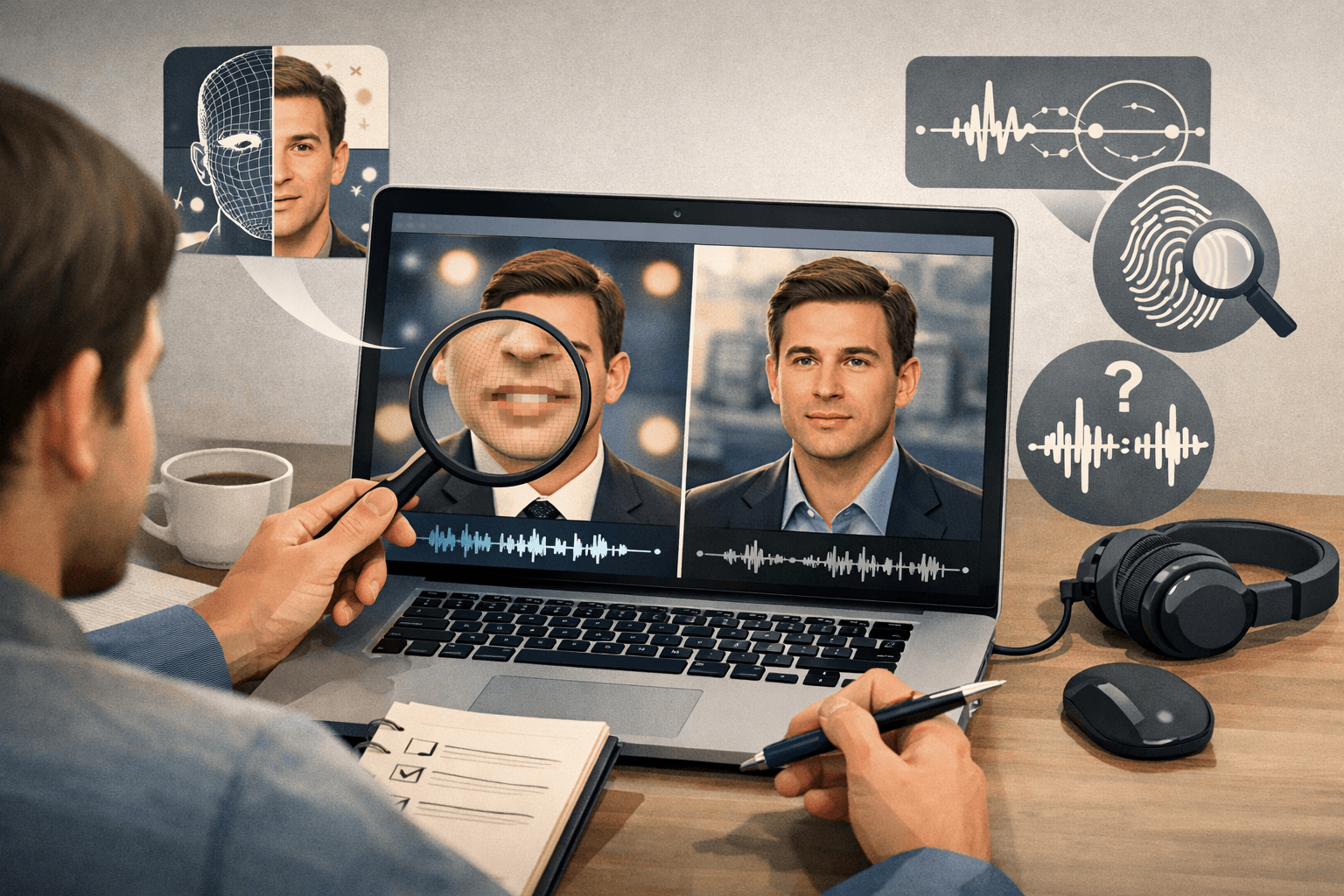
Review the video at reduced speed if the platform supports it. Look for:
- The mouth and audio falling out of sync on plosive sounds, word endings or when the speaker turns their head.
- Unnatural changes in mouth shape; teeth or the tongue becoming distorted in some frames.
- Lighting on the face that does not match the background; blurred or flickering edges around the hair, ears or face.
- Facial expressions, blinking, neck movements and hand movements repeating in a mechanical way.
- Sudden background noise, “metallic” consonants, implausible breathing patterns or a voice that changes when the speaker talks quickly.
- A fluent statement whose intonation, word choice or reactions do not match the person’s familiar style.
Do not conclude that a video is genuine simply because you see no flaws. Generative technology can produce highly convincing content, while compression, editing or low-resolution playback can remove both real and artificial indicators. Conversely, audio problems in a poor-quality call are not enough to conclude that the voice is AI-generated.
5. Look for displayed labels and Content Credentials
Check the description, information panel or labels such as “AI-generated,” “altered or synthetic content,” “made with AI” and equivalent wording used by the platform. A label may indicate only that part of the image or audio was generated or altered; it does not necessarily mean the entire video is fake.
You can also look for Content Credentials, which are commonly based on the C2PA standard. This is digitally signed provenance information that may show when the content was created, which tools were used and what edits it underwent. Content Credentials help verify the history and integrity of provenance data, but they are not a “seal” confirming that a video is truthful; viewers still need to assess the identity, context and message (according to c2pa.org).
If Content Credentials are absent, that means only that you do not have provenance data from this standard. It does not automatically prove that the video is fake. Conversely, provenance information does not guarantee that the content is true if the signing source is untrustworthy or the data provided is incomplete.
6. Verify through another channel before taking action
If the content requests money, account access, an authentication code or urgent action, use a communication channel that you find yourself. Do not call back a phone number in a suspicious message or click a link provided by the sender.
For example, if an account claiming to belong to a public figure asks you to send money to “join a project,” open the person’s official website, management company’s website or organizer’s website by finding the address yourself. Call or email using contact information you already knew; do not send money simply because the other party provides an additional personalized video. The FTC advises people not to automatically trust a voice in an emergency; end the call and contact the person again using a number you already know (according to consumer.ftc.gov).
The process ends when: you act only after identifying the source, cross-checking the statement and verifying the request through an independent channel. If any of these steps fails, keep the status as “unverified” and do not send money, provide codes or share the content widely.
What do deepfake labels under the EU AI Act mean?
Article 50 of the EU AI Act establishes different transparency obligations for providers and deployers of certain AI systems. The Act’s general provisions begin to apply on 2 August 2026. Transitional provisions and the status of specific systems may affect when the rules apply, so businesses should not infer obligations for all of their activities solely from a general-purpose guide (according to digital-strategy.ec.europa.eu).
| Subject or type of content | Main implication of the obligation | What should viewers understand? |
|---|---|---|
| Providers of AI systems that generate outputs | Where technically feasible, audio, image, video or text outputs must be marked in a machine-readable and detectable manner. | The file may contain provenance data or technical markers that platforms and verification tools can read. |
| Deployers that create or edit content | Where Article 50 applies, they must clearly disclose when image, audio or video content is a deepfake. | Human-readable labels must be clearly visible or audible; a machine-readable marker alone does not fully replace this notice. |
| Artistic, creative, satirical or fictional works | The disclosure method may be adapted so as not to impair the audience’s enjoyment of the work, but the existence of artificial content must still be indicated in an appropriate manner. | Fictional content is not therefore to be treated as a genuine statement by the public figure. |
This is an EU regulation, not a legal standard that automatically applies in every country. If you create content or operate a service across multiple markets, also check the laws where you operate, platform rules and industry requirements. This article does not replace legal advice for an advertising campaign, a voice-licensing agreement or a specific case.
A checklist for examining a specific piece of content
- Preserve the evidence: record the URL, account name and posting time, and download a copy if the platform allows it. If the content disappears, a screenshot and the URL can still help document what happened.
- Record the claim to be checked: transcribe the statement, product name, event name and call to action.
- Find the original source: search for the statement and the public figure’s name on official channels, the brand’s website or original documents.
- Check labels and provenance: review the platform’s information panel, AI labels and Content Credentials, if available.
- Listen to and watch it again: use the audio and visual indicators from step four to look for anomalies, but do not treat them as the sole evidence.
- Check the call to action: enter the brand’s or organization’s web address yourself; do not use links in a suspicious video or message.
- Make a decision: if there is no independent confirmation, mark it as “unverified,” do not transfer money or provide codes, and do not share it as fact.
You can use this note-taking template: Nguồn đăng – nguồn gốc đầu tiên – phát ngôn chính – nhãn AI – Content Credentials – nguồn xác minh độc lập – hành động an toàn. This template helps distinguish “I watched the video” from “I verified the claim in the video.”
Common mistakes that lead viewers to misidentify content
- Focusing only on the eyes, teeth or hands: these signs are unreliable after compression, cropping or re-encoding.
- Trusting a single deepfake-detection tool: the tool may produce false results, especially with new content, short audio clips or low-quality copies.
- Assuming that an AI label means the content is dangerous: the label indicates artificial provenance; it does not, by itself, establish the intent or truthfulness of the content.
- Assuming that no label means the video is genuine: the label may be missing, incompatible or stripped when the content is reposted.
- Moving to a private conversation: an impersonator may create a sense of intimacy and isolate the victim from people who could help verify the claim.
- Sharing first and checking later: screenshots, downloaded copies and reposts can continue circulating even after the original post has been deleted.
If you have already transferred money or provided information, contact your bank, payment platform or mobile carrier immediately to ask whether the transaction can be blocked; change your passwords, enable multi-factor authentication, and preserve the URL, messages, receipts and screenshots. Report the impersonating account to the platform and to the relevant fraud-reporting authority where you live.
Conclusion: verify the message, not just the face
A more reliable way to identify a celebrity deepfake is to ask four questions: Who posted it? Has the content been confirmed by an independent source? Does it carry an AI label or provenance data? What does the poster want you to do right now?
For a cloned voice, treat the voice as a signal that can be copied, not as proof of identity. For video, treat labels and Content Credentials as supporting evidence, then check the source, context and purpose. If the answer is still unclear, the safe choice is not to share the content, transfer money or make a decision based on the video.
If you are interested in real-world disputes concerning voice protection against deepfakes, you can also read the story of Taylor Swift’s efforts to protect her voice from AI.
Reference source
- Transparency obligations under Article 50 of the AI Act — European Commission.
- Guidelines on transparency obligations for providers and deployers of certain AI systems — European Commission.
- Regulation (EU) 2024/1689 — EUR-Lex.
- C2PA and Content Credentials Explainer — C2PA Specifications.
- Did a celebrity really endorse THAT? Maybe not — FTC Consumer Advice.
- Scammers Use Fake Emergencies To Steal Your Money — FTC Consumer Advice.
