






If the lactate threshold on your Amazfit Balance 3 changes after an update, do not immediately increase your pace or turn the next run into a fitness test. OTA 4, recorded in July 2026, optimized the Running Lactate Threshold algorithm; OTA 6, recorded in August 2026, improved the VO₂ max algorithm but did not announce a specific change to lactate threshold (according to us.amazfit.com). Therefore, treat the new value as an estimate that needs to be checked in context—not as conclusive evidence that your fitness has improved.
The practical goal is to use lactate threshold as a reference point for limiting the intensity of goal-oriented runs. Pace, heart rate, perceived exertion, sleep, weather, terrain, and recovery capacity still need to be considered together. A single number on your watch should not determine your entire training schedule.
What is lactate threshold?
Lactate threshold is an intensity marker associated with the point at which blood lactate begins to accumulate faster than the body can process it. In running, this is usually a high level of exertion but not an all-out sprint; once you exceed this point, fatigue can increase rapidly and your ability to sustain the effort can decline. It is a physiological concept used to guide intensity, not a mandatory pace for every run (according to us.amazfit.com).
Lactate threshold does not mean “run all-out.” Easy runs, recovery runs, and rest days help you absorb your training load. Near-threshold sessions are only one component of a training plan. If you turn long runs, easy runs, and recovery runs into threshold tests, you may accumulate fatigue even when the numbers on your watch still appear reasonable.
How do OTA 4 and OTA 6 differ on the Balance 3?
According to the update information provided for the Balance 3, OTA 4 in July 2026 optimized the Running Lactate Threshold algorithm. OTA 6 in August 2026 improved the accuracy and stability of the VO₂ max algorithm, along with other changes such as peripheral-device connection reminders, screenless device management, wrong-way alerts, and several map improvements. The release notes do not identify OTA 6 as a dedicated lactate-threshold optimization.
The important point is that different versions may use different calculation or calibration methods. Do not therefore compare a pre-update value with a post-update value mechanically, as if both had been produced by the same measurement process. Updates may also be rolled out in stages, so your device may not receive the same version at the same time as the announcement.
To check, use the Zepp app on your phone: open the Balance 3 device page, find the system-update section, and record the current version number. If Zepp has not displayed the update, do not assume that the algorithm has changed simply because a new value appeared after a run.
Check the data before changing your training schedule
- Record the software version. Record the OTA version currently installed on the Balance 3 in Zepp. Distinguish between OTA 4 from July and OTA 6 from August, because the two release notes describe different changes.
- Record all relevant metrics. Record the lactate threshold, threshold heart rate, and threshold pace if Zepp displays them. Do not record heart rate alone: pace is also affected by gradient, wind, temperature, GPS, and the running surface.
- Record the conditions of the run. Note your sleep duration, weather, terrain, type of heart-rate sensor, warm-up duration, and level of fatigue before the run. A hot, sleep-deprived, or hill-heavy run is not a sound basis for setting a new pace benchmark.
- Compare the data with perceived exertion. If the watch reports a higher threshold but the corresponding pace leaves you out of breath early, unable to speak in short sentences, or experiencing unusual pain, maintain the previous level or reduce the training load. Your bodily sensations are important validation data.
- Wait for a repeated trend. Consider changing your schedule only when the change appears across relatively similar sessions and is not accompanied by prolonged fatigue. A single jump in the number is not enough to increase training volume or intensity.
If you want to perform a structured threshold test, some Amazfit devices may offer the Workout > Outdoor Running > Training > Lactate threshold test. Menu names and availability may vary by watch model and software version. Confirm the option directly on your device before starting; do not assume that instructions for another model necessarily apply to the Balance 3 (according to support.amazfit.com).
Using lactate threshold for different types of runs
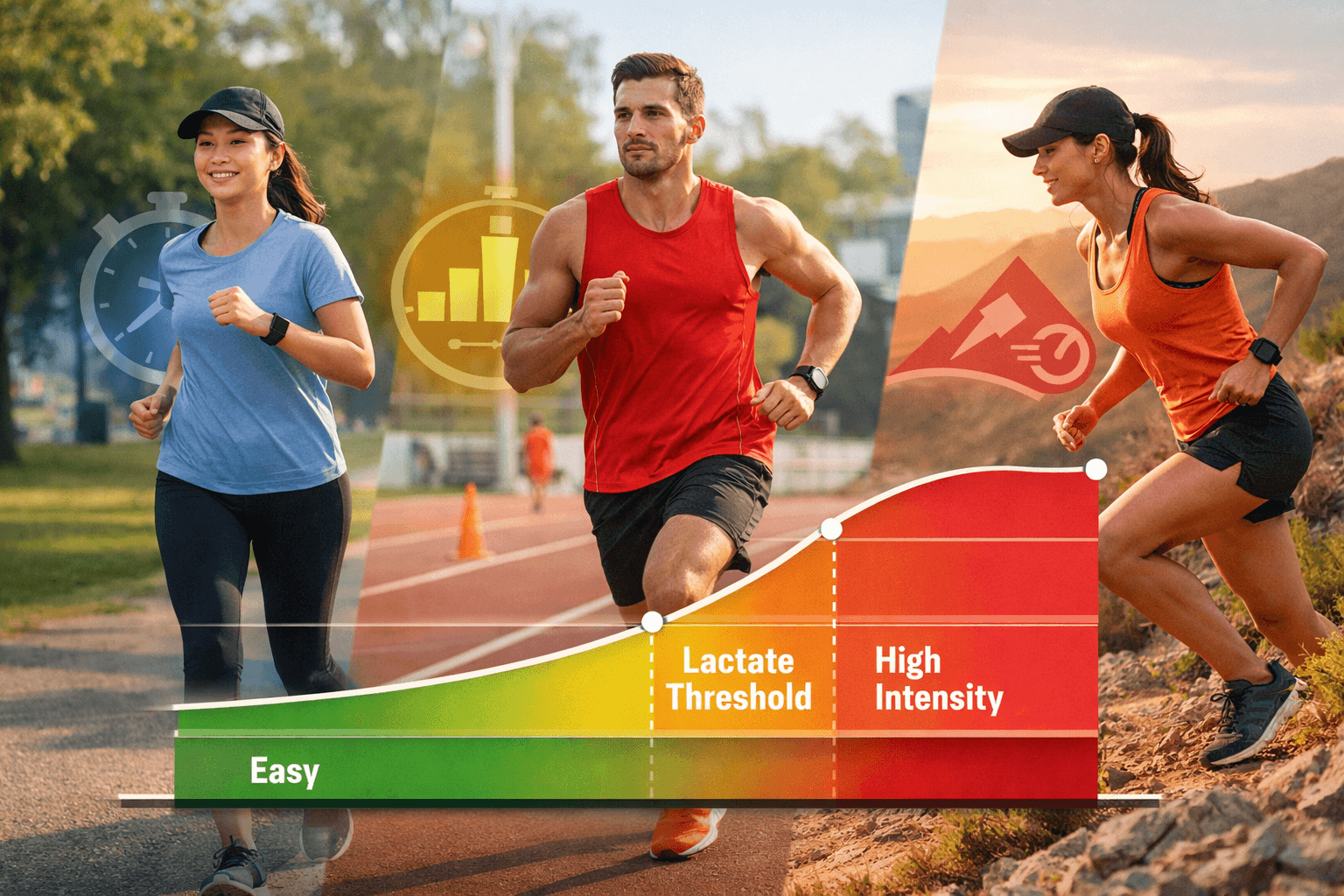
Treat lactate threshold as a reference ceiling for goal-oriented runs, not as a minimum pace for every day. The table below is a reference framework for beginners or runners returning to training; it is not an individualized plan.
| Run type | How to use the data | When to maintain or reduce intensity |
|---|---|---|
| Easy or recovery run | Run well below threshold; prioritize being able to talk and finishing with the effort still under control. | If your heart rate rises unusually, your legs feel heavy, or you have to strain to maintain your usual pace, slow down. |
| Long run | Keep the intensity steady; do not use the new threshold to speed up the first half of the run. | If your pace gradually declines, your form deteriorates, or fatigue persists after the run, reduce the pace or duration next time. |
| Near-threshold run | Use threshold pace and heart rate as reference points; start slightly below them, then assess how the effort feels. | If you cannot maintain an even effort or must keep accelerating to reach the numbers, the run is too demanding. |
| Intervals or hill running | Do not use lactate threshold as the sole target; fast segments may exceed threshold. | If recovery takes unusually long or the quality of later repetitions drops sharply, reduce the number of repetitions or increase the recovery time. |
Illustrative example with hypothetical data
Assumption: The Balance 3 displays a threshold pace of 5:30 minutes per kilometer and a threshold heart rate of 165 beats per minute. These are illustrative figures only, not a recommendation for you.
- Monday: rest or take an easy walk.
- Tuesday: Run easily for 30–40 minutes; do not force yourself to reach 5:30 min/km. If it is hot or your heart rate rises quickly, slow down.
- Wednesday: Rest or do light strength training.
- Thursday: Warm up, then run near threshold in short, controlled intervals. The goal is to maintain an even effort, not to stay above 165 beats per minute for as long as possible.
- Friday: Rest or do a very easy recovery run if your body feels normal.
- Weekend: Run long at an easy to moderate intensity. Do not turn the second half into a race just because the watch reports a higher VO₂ max or lactate threshold.
After each run, record three items: planned intensity, actual intensity and how you feel the next day. If the watch says you are “better” but your body needs several days to recover, the training schedule does not match your current condition.
Should VO₂ max be a reason to speed up?
VO₂ max is an estimate of your maximum oxygen-utilization capacity, whereas lactate threshold is a different intensity marker. The two metrics can complement each other, but neither replaces the other. An increase in VO₂ max after OTA 6 does not automatically show that your threshold pace should also increase.
Use VO₂ max mainly to track trends under reasonably consistent conditions: the same type of activity, sufficiently stable GPS and heart-rate signals, and no major differences in weather or terrain. If the value fluctuates sharply after a short or hilly run, or when the heart-rate signal is poor, treat it as data that needs checking—not as an instruction to increase intensity.
When should you reduce training load or stop running?
Stop the run or switch to walking if you experience chest pain, fainting, unusual shortness of breath, confusion, unusual weakness, or any feeling that your body is not safe to continue. If you have localized pain that is getting worse, pain that changes your running form, a fever, or prolonged fatigue, do not force yourself to finish the workout just to meet a watch-based target. If symptoms are severe or do not improve, seek appropriate medical evaluation.
Hot, humid weather can raise your heart rate and perceived exertion even when your pace remains unchanged. On such days, prioritize a comfortable duration and your ability to recover rather than rigidly sticking to the threshold zone. You can review how to interpret WBGT when running outdoors to determine when to reduce intensity or stop the workout.
Checklist before trusting a new lactate-threshold reading
- Have you identified which OTA update preceded the change in value?
- Does the new value come with clear pace, heart-rate, and measurement-condition data?
- Did the run that produced the value include an adequate warm-up and remain relatively steady?
- Does your perceived exertion match the data?
- Are you planning to increase your pace, duration, and number of runs at the same time? If so, change only one factor.
- Did your body recover normally before the next run?
Conclusion: Based on the published information, OTA 4 and OTA 6 for the Amazfit Balance 3 concern different algorithms. New data is not an instruction to run faster. A safer approach is to check the software version and measurement conditions, track trends across multiple comparable runs, and adjust each element of your training schedule using both the watch data and your body’s feedback.
Reference source
