






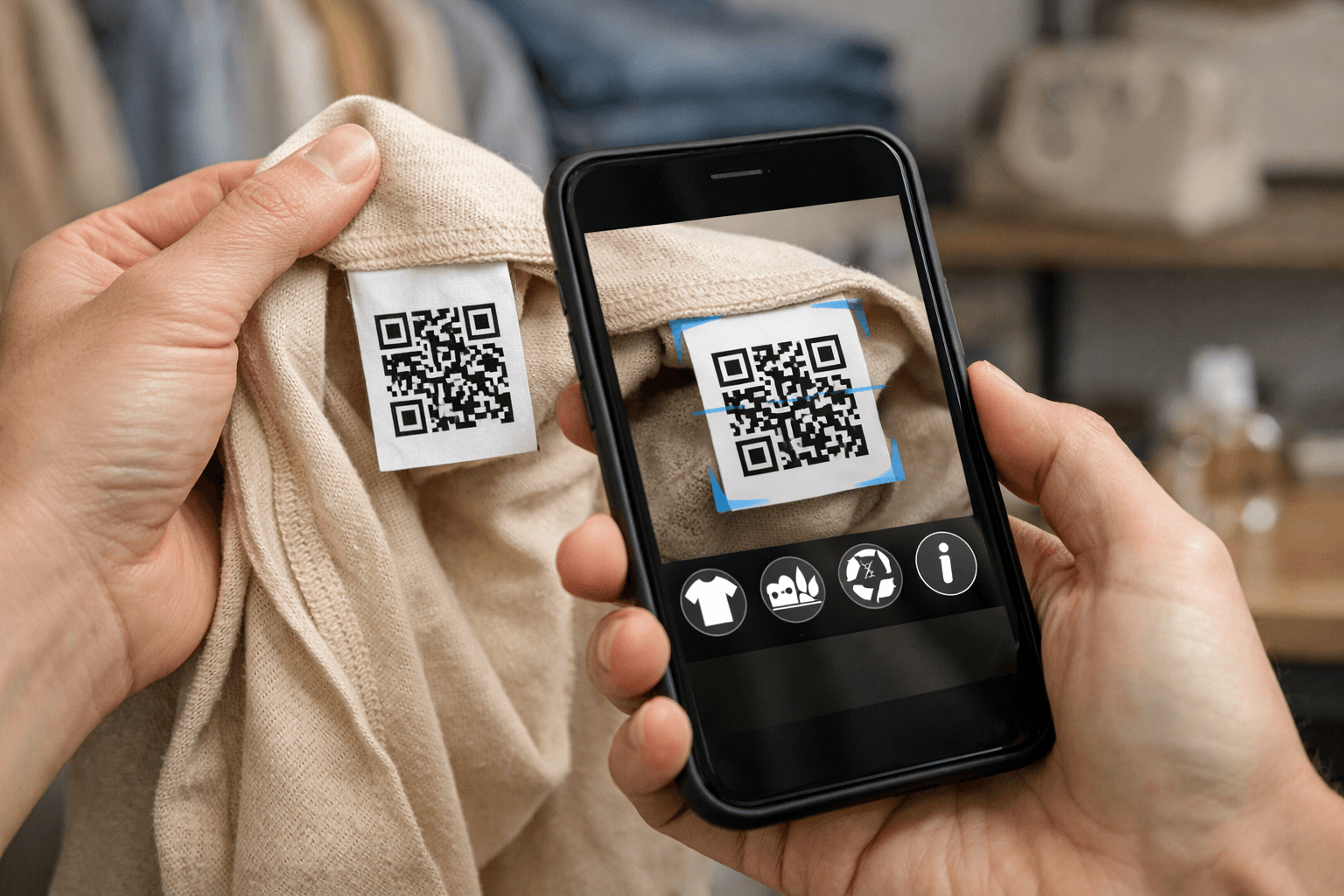
Fashion Digital Product Passport is a digital data record linked to a garment, usually accessible via a QR code, NFC tag, or another data carrier. When you scan the code, you can see not only the fabric composition but also check the product’s origin, use instructions, repair and reuse options, and end-of-life handling.
However, not every QR code on clothing is a complete Digital Product Passport. A code that leads only to an advertising page or general brand information is not enough to demonstrate product transparency. Buyers should read the information in this order: what the product is, where it was made, how to use and care for it, and finally how it can be repaired or recycled.
What is a fashion Digital Product Passport?
Within the European Union, the Digital Product Passport is designed as an electronic “data repository” for products, components, or materials. The data must be accurate, complete, up to date, and linked to a unique product identifier. A QR code is a common way to display it, but the regulations are not limited to QR codes; two-dimensional barcodes or equivalent identification technologies may also be used (according to eur-lex.europa.eu).
For textiles, the EU has identified this as a priority product group. As of August 23, 2026, specific requirements for textiles are still being developed under a separate delegated act; the European Commission is expected to adopt this act in the fourth quarter of 2027, although the implementation timeline may change (according to single-market-economy.ec.europa.eu).
This means that, on today’s market, a shirt with a QR code may not necessarily comply with a single mandatory, harmonized textile DPP standard. You should treat the QR code as an information-checking tool, not an automatic seal of assurance.
Scanning Clothing QR Codes: Read These 5 Key Information Groups
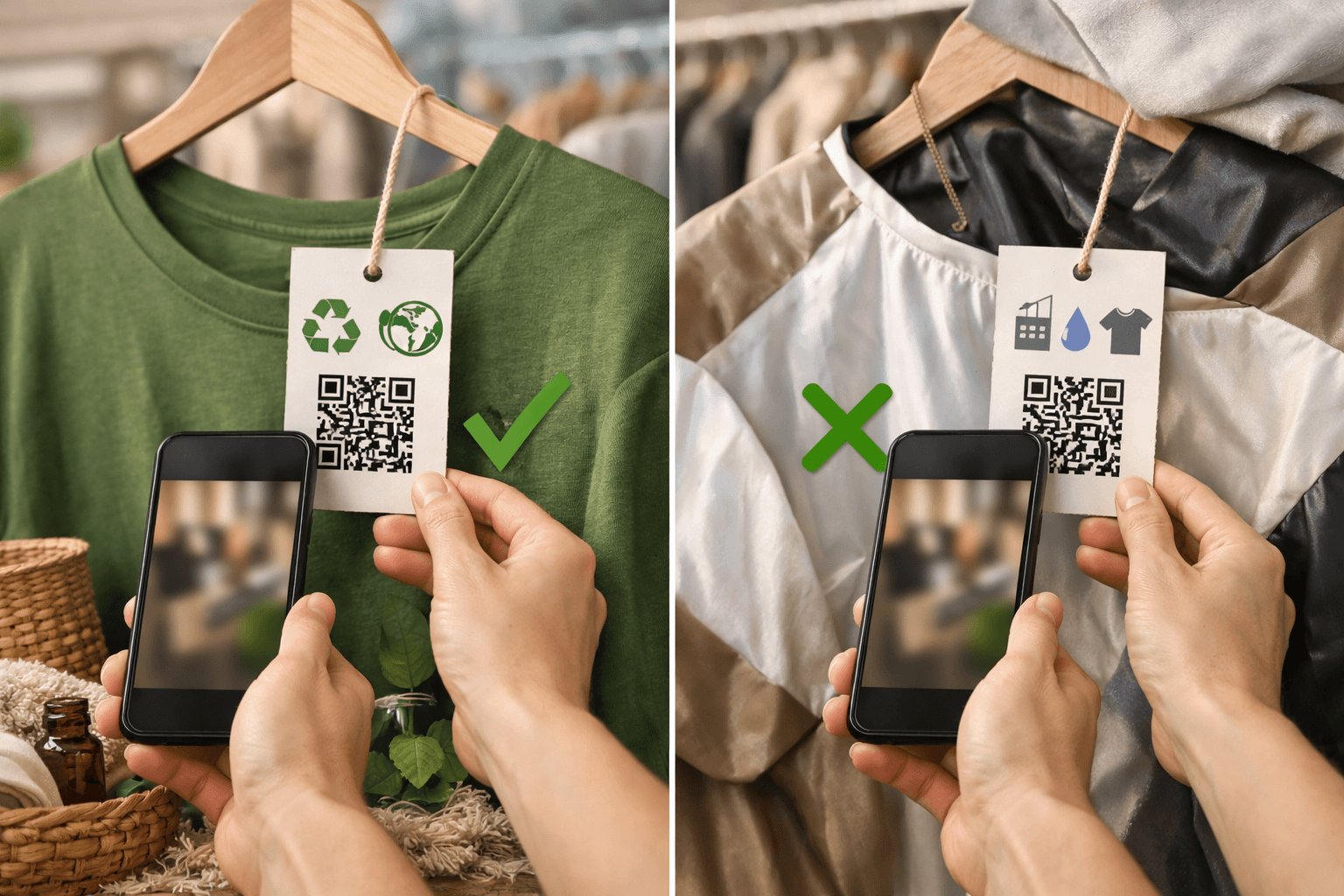
Greenwashing often occurs when brands use positive language but provide no scope, measurement method, or evidence. A claim such as “reduced environmental impact” should state which factor was reduced, compared with what baseline, and based on which method.
In a review of sustainability claims, the European Commission found that approximately 39% of claims in the textiles, clothing, and footwear sectors could be false or misleading (according to environment.ec.europa.eu). This figure does not mean that every brand is untrustworthy, but it shows that buyers need to check the evidence rather than simply read the slogans.
| Sign | More trustworthy information | Question you should ask |
|---|---|---|
| “Environmentally friendly” | Clearly states the material, scope, and assessment method | In what respect is it environmentally friendly? |
| “Recycled fabric” | Provides the percentage of recycled fibers and the source of the material | Recycled from what material? |
| “Responsibly produced” | Provides the facility name or code, production stage, and applicable standard | How is responsibility verified? |
| “Recyclable” | Explains how to disassemble it and identifies collection points | Where is this product actually accepted? |
| “Low carbon” | Provides the measurement unit, life-cycle boundaries, and data year | Which stages have been included in the calculation? |
Prioritize records with downloadable data, an update date, verification documents, and a clear distinction between mandatory and voluntary information. If the page contains only images of nature, vague promises, and no product code, treat it as marketing content rather than traceability information.
A 60-Second Checklist Before Buying Clothes
- Scan the code with your phone’s camera; do not install apps from unclear sources.
- Match the model name, color, size, and product code with the actual item.
- Read the fiber percentages and check additional components such as the lining, zipper, and coating.
- Look for the sources of the materials and the production stages, not just the location of final assembly.
- Check the washing instructions, repair options, warranty, and expected service life, if available.
- Look for instructions on resale, take-back, reuse, or recycling.
- Flag environmental claims that provide no figures, scope, or evidence.
- If the data is too sparse, base your decision on durability, suitability, and the likelihood of long-term wear rather than sustainability slogans.
A fashion Digital Product Passport can turn a clothing QR code into a tool that helps buyers, repairers, and recyclers better understand a product. But its value depends on the quality of the data and how it is presented. As a buyer, you do not need to read the entire record: simply check the five key information groups—identification, composition, origin, care, and end of life.
That is how to turn a Digital Product Passport from a technological feature into a practical basis for circular fashion choices: buy less, use items longer, and handle them more appropriately when they are no longer needed.
Reference source
