






Mineral sunscreen without a white cast is not an impossible choice, even if you have a deep skin tone. A white cast often appears because zinc oxide or titanium dioxide particles sit on the skin’s surface, compounded by an overly thick formula, uneven application, or using a large amount all at once.
A practical solution is to prioritize micronized mineral products, formulas that blend into your skin tone, or products containing pigments that help neutralize the white layer; at the same time, divide the amount of sunscreen into two thin applications instead of trying to spread it all at once. The product should still have an SPF of 30 or higher, clearly state broad-spectrum protection, and suit your skin type (according to aad.org).
Why does mineral sunscreen tend to leave a white cast?
Physical sunscreens use mineral filters such as zinc oxide and titanium dioxide. They form a protective layer on the skin and can scatter light, making the surface look whiter or grayer than its natural skin tone. This effect is more noticeable on medium to deep skin tones, especially when the product has a thick texture or a high concentration of mineral powder.
This does not mean mineral sunscreen provides less protection. The issue lies in particle dispersion, the formula’s base, and the product’s shade. Some modern formulas use micronized mineral particles to reduce a chalky appearance. However, “micronized” does not necessarily mean non-tone-up zinc oxide; you should still test it directly on the skin near your jawline.
If your skin is easily irritated, mineral sunscreen may be worth considering because zinc oxide and titanium dioxide are often recommended for sensitive skin. Whatever type you choose, check the label for “broad spectrum,” the SPF, and water-resistance instructions rather than focusing only on the terms “physical” or “mineral” (according to aad.org).
How to choose mineral sunscreen without a white cast
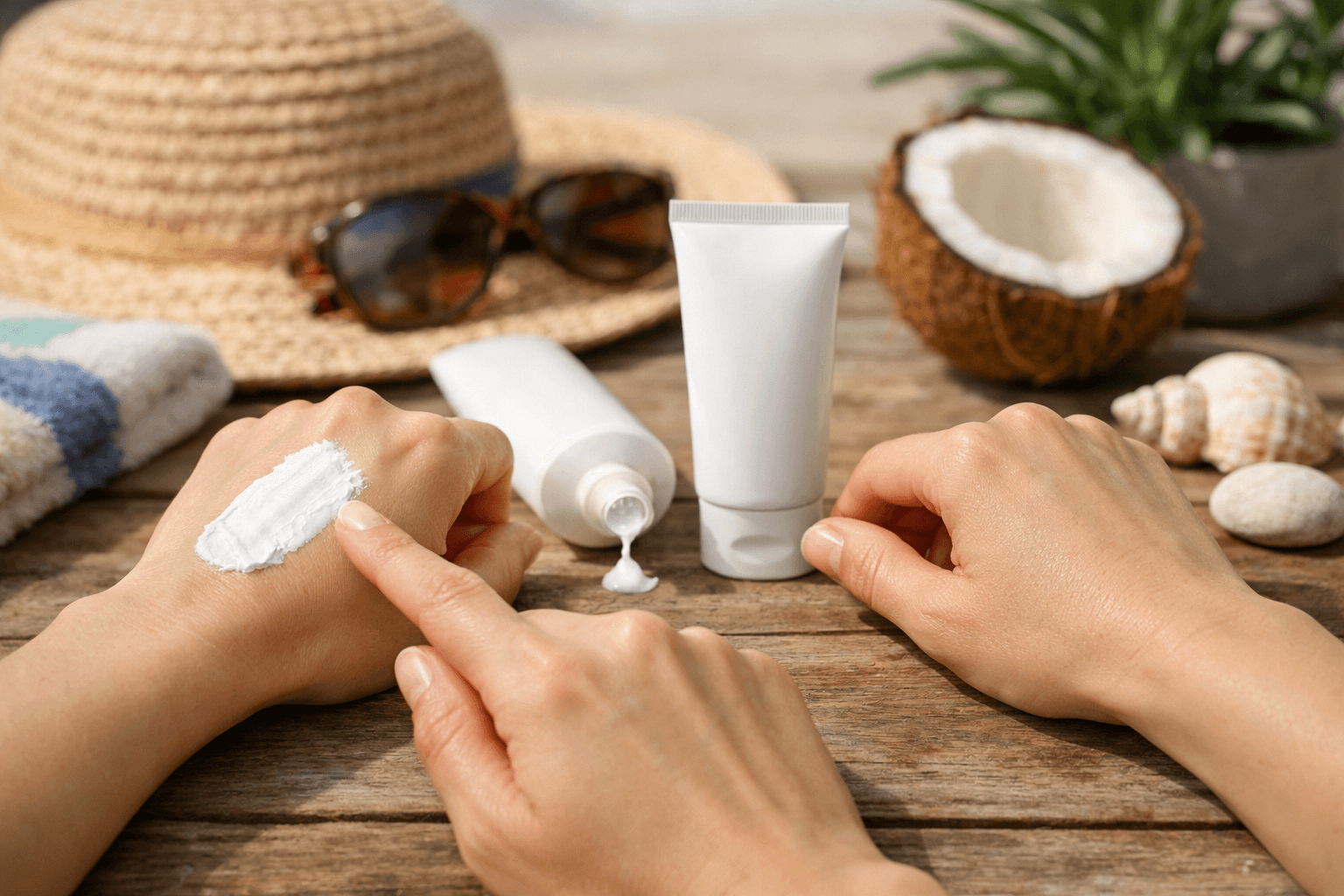
1. Prioritize micronized or tinted formulas
On the packaging, look for descriptions such as “micronized,” “sheer,” “blended,” or “tinted.” Tinted sunscreens usually contain pigments that help the mineral layer blend more naturally with the skin. For those who need sunscreen for deep skin tones, tinted sunscreen in brown, beige, or caramel shades is often easier to use than the original white version.
If you have post-acne marks or melasma, products containing iron oxides may be more helpful because these pigments help reduce the effects of visible light on hyperpigmented areas; the product should still have an SPF of 30 or higher and broad-spectrum protection (according to aad.org).
2. Choose a base suited to your skin type
- Oily skin: choose a fluid, gel-cream, or lightweight lotion, and look for “non-comedogenic” if you are prone to clogged pores.
- Dry skin: prioritize a moisturizing base, but avoid applying too many oily layers beforehand because the sunscreen may slide around and pill.
- Sensitive skin: consider fragrance-free products with few potentially irritating ingredients, and patch-test first on a small area.
- Deep skin tones: test the shade in natural light; a shade that is too light can create a gray cast even when the cream has been blended evenly.
You can also explore a minimalist skincare routine for different skin conditions to adjust the moisturizing layers applied before sunscreen.
3. Do not sacrifice protection for a transparent finish
A product that is nearly transparent but does not clearly state its SPF, provide broad-spectrum protection information, or makes you apply only a very thin layer is not necessarily a good choice. According to the FDA, sunscreen should be applied about 15 minutes before sun exposure, used in a sufficient amount, and reapplied at least every two hours when outdoors; reapply sooner if you swim or sweat (according to FDA).
How to apply sunscreen without a white cast or pilling
- Prepare the skin’s surface: wait for your moisturizer to absorb reasonably well, and avoid leaving the skin too wet or too slippery.
- Apply it in two rounds: use the two-finger rule for the face and neck according to the product instructions, but apply half first, wait about 30–60 seconds, then apply the remaining half.
- Dot it evenly before blending: place small dots on the forehead, cheeks, nose, and chin to reduce the product collecting in patches.
- Blend one area at a time: use your fingertips to gently rub or pat on a thin layer; do not continuously drag the product around because this can lift the sunscreen and cause pilling.
- Check in natural light: inspect the jawline, hairline, sides of the nose, and neck. If there is still a white cast, gently press it in with a clean, damp sponge instead of applying another thick layer.
A common mistake is mixing sunscreen with foundation or moisturizer to thin it out. This can make the product layer less uniform and reduce the amount of UV filters on the skin. Instead, choose a tinted version or a fluid formula with good spreadability from the outset.
If you still see a white cast after applying it correctly, the product may not match your skin tone or its formula may not suit you. In that case, switch to a tinted mineral sunscreen, try another micronized formula, or consider a hybrid sunscreen if your skin is not highly sensitive to chemical filters.
In summary: to choose mineral sunscreen without a white cast, check three factors: micronized mineral particles, a shade that blends with your skin, and an easy-to-spread texture. For deep skin tones, tinted sunscreen is often the most practical choice; for sensitive skin, prioritize a simple, fragrance-free mineral formula and always patch-test it on a small area first.
Reference source
