






The short answer: Michael Jackson’s fashion exhibition helps viewers reread his stage image by taking objects that usually appear only in photographs or videos out of the flow of movement and placing them alongside the stories of the performances. This makes clear that Jackson’s clothing was not merely finishing decoration; it helped shape his silhouette, emphasize rhythm, construct character and preserve collective memory.
Exhibition Michael Jackson: The Fashion Legacy at the Museum of Pop Culture (MOPOP) in Seattle is scheduled to run from August 22 to September 7, 2026. This is a short-term exhibition featuring about a dozen artifacts and organized in collaboration with Julien’s Auctions, rather than a comprehensive retrospective of Jackson’s entire career (according to mopop.org).
The exhibition places clothing back within the moment of performance
A suit in a display case cannot recreate the sound, lighting, or thousands of spectators. However, the exhibit label and its connection to a performance help viewers place it within the right cultural coordinates: when was it worn, which video did it appear in, which dance was it associated with, and why is that image still remembered?
This represents an important shift in how we look at the clothing. If we see only photographs of Michael Jackson, it is easy to think of his outfits as identifying markers. When we look at the actual artifacts, we can ask more specific questions:
- Do the shoulders, lapels, or cut make the body appear broader and more powerful?
- How do glossy fabrics, rhinestone details, or contrasting colors respond to stage lighting?
- Do the shoes support movement and balance, or do they primarily carry symbolic value?
- Was the outfit designed for a single moment, or could it be reused across multiple performances?
The exhibition therefore asks not only, “What did Michael Jackson wear?” but also, “What did that outfit do for the performance?”
The moonwalk shoes show how clothing can become part of choreography
One of the most important points of analysis is the pair of shoes associated with the performance on the special program Motown 25, where Jackson introduced the moonwalk to a television audience. This artifact is directly linked to the moment that transformed a dance move into a global icon, but the sources used here do not provide complete specifications for the shoes’ construction, traction, or weight.
Here, the shoes are no longer accessories standing outside the choreography. The sole, the floor’s traction, the shape of the toe, and the way light catches the surface are all factors to consider when analyzing how the audience sees the movement. When Jackson glides backward, viewers are not merely “looking at” a pair of shoes; they are seeing the illusion of a body moving backward without taking a step forward.
This helps us understand the stage as a coordinated system involving the body, clothing, stage floor, and camera. A famous movement does not exist independently of the material and visual conditions that make it visible.
Jackets and suits turn an image into a recognizable silhouette
Clothing from the Thrillerera, the white-and-blue suit from “Smooth Criminal,” and jackets associated with the Bad Tour show how Jackson built his image through strong lines: defined shoulders, a streamlined torso, contrasting colors, and light-catching details. The artifacts presented at MOPOP include a jacket from the “Thriller” video, the Motown 25 shoes, the “Smooth Criminal” outfit, a Bad Tour jacket, and a rhinestone glove (according to juliensauctions.com).
These details create a silhouette that can be recognized even when the face is not clearly visible. From a distance, the audience can still make out the shoulders, hat, glove, dark trousers, or patches of light moving with the body. This visual strategy is particularly effective in stadiums, on television screens, and in still photographs.
We might call this Jackson’s “visual grammar”: certain elements recur often enough to become signs, while each appearance is still adapted to the song, narrative, or creative period.
Stage fashion is engineering, not just style
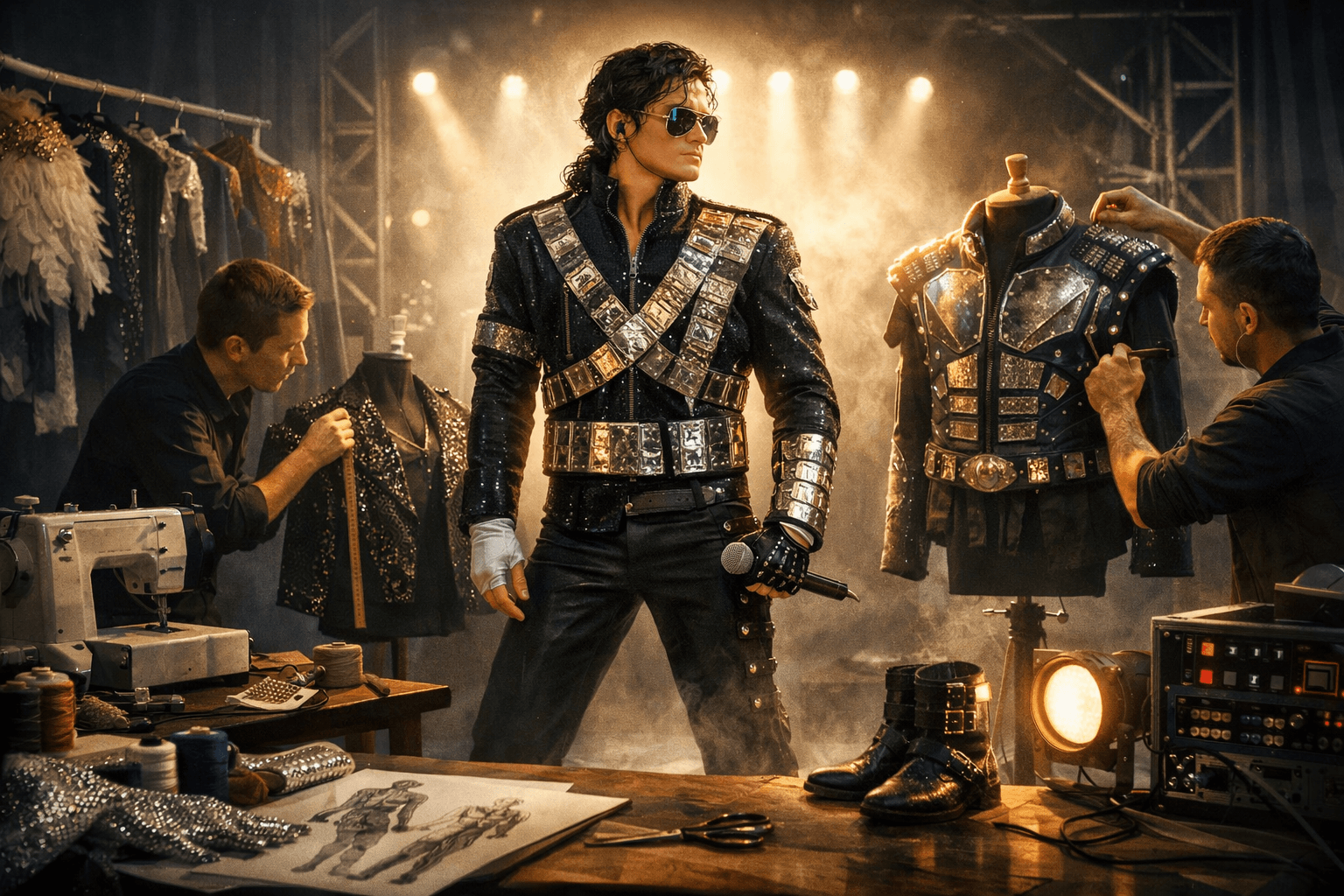
Beginners often judge performance clothing by two criteria: whether it looks good and whether it resembles everyday clothing. For stagewear, those criteria are not enough. An outfit must also address technical requirements:
- Visibility from a distance: the lines must remain clear under strong lighting and before a large audience.
- Freedom of movement: jackets, trousers, shoes, and accessories must not impede fast movements.
- Illusion-making: materials, colors, and shapes can make a movement appear more powerful or more mysterious.
- Transformation of the image: a jacket, glove, or hat can shift a character from everyday life into a stage icon.
For this reason, when viewing Michael Jackson: The Fashion Legacy, it is worth observing what is “not visible” as well: how heavy might the outfit be, which parts may have been reinforced, which details serve only a visual purpose, and which must support movement? The exhibition may not provide complete technical specifications for every item, so viewers need to distinguish between what is explicitly documented and what they are interpreting.
An artifact’s history broadens our understanding of its legacy
An outfit has more than a history onstage. It also has a history of ownership, preservation, gifting, and circulation in the memorabilia market. For example, a Bad Tour jacket is described as having been given by Jackson to Tony Martell to raise funds for the T.J. Martell Foundation. This detail allows the artifact to be understood as an object connected to social causes and the relationship between an artist and the community, rather than merely as “a jacket that was once worn.”
Legacy therefore lies not only in the moment when the artist appeared onstage, but also in the paths an artifact took afterward. An item can simultaneously be a costume, historical evidence, a collectible, and an auction commodity. However, auction value does not automatically equate to historical or artistic value.
Limits to keep in mind when reading the exhibition
The exhibition offers valuable prompts for interpretation, but it should not be treated as the complete history of Michael Jackson’s fashion. Its short duration and limited number of artifacts necessarily mean that the narrative prioritizes famous moments. Less-discussed periods, designers, tailors, dancers, technicians, and fitting processes may not be fully represented.
In addition, much of an artifact’s meaning comes from its caption and accompanying media context. Viewers should separate three layers of information:
- What can be verified: what the item is described as, which event or video it is associated with, and which collection or institution it belongs to.
- What can be inferred: how its shape, color, and materials might support the creation of form or movement.
- What belongs to interpretation: whether the item evokes power, mystery, militarism, or the surreal.
Distinguishing these three layers helps viewers avoid turning personal impressions into historical fact.
How to analyze a stage image through a single artifact
You can use the following four-step process when viewing an exhibition photograph, archival video, or a similar artifact:
- Identify the object: is it a shoe, jacket, suit, glove, or accessory?
- Connect it to a moment: in which performance, video, tour, or photo shoot did it appear?
- Observe its function: Does it make the body stand out, support movement, catch the light, or create a visual transition?
- Assess its legacy: Why is the image still recognizable when separated from its original sound?
Using this process, a pair of shoes is no longer merely a moonwalk keepsake; it becomes a point of intersection between performance technique, television, and cultural memory. A single glove is not merely a “Michael Jackson” symbol; it shows how a small detail can stand in for an entire stage persona.
Conclusion: The Michael Jackson fashion exhibition invites us to reread the stage by showing how performance images are built from concrete objects. Clothing shapes the body, emphasizes movement, supports the narrative, and turns a brief moment into a symbol that can endure. To understand the exhibition fully, however, viewers should consider both the objects and their context, while distinguishing confirmed facts from inference and personal interpretation.
Reference source
- Michael Jackson: The Fashion Legacy — Museum of Pop Culture.
- Michael Jackson: The Fashion Legacy Lands at MoPOP — Julien’s Auctions.
