






The short answer: Messi played in six World Cups from 2006 to 2026. Argentina lost 1–0 to Germany after extra time in the 2014 final, won Qatar 2022 after beating France in a penalty shoot-out, then returned to the 2026 final but lost 1–0 to Spain after extra time. Therefore, the 2026 World Cup is the last tournament already played within the journey covered by this article; that does not automatically mean Messi has officially announced his retirement from international football.
This journey matters for more than its titles. Across six tournaments, Messi evolved from a young substitute into Argentina’s captain and central figure.
Messi’s Six World Cups at a Glance
| World Cup | Argentina’s result | Messi’s role and key contributions |
|---|---|---|
| 2006, Germany | Quarter-finals | Made his debut as a teenager, providing an assist and scoring in the 6–0 win over Serbia and Montenegro. |
| 2010, South Africa | Quarter-finals | A key star, but Argentina lost 4–0 to Germany. |
| 2014, Brazil | Runners-up | Led Argentina to the final, where they lost 1–0 to Germany after extra time. |
| 2018, Russia | Round of 16 | Argentina lost 4–3 to France in a seven-goal thriller. |
| 2022, Qatar | Champions | Scored or assisted in every knockout round, won the Golden Ball and lifted the trophy. |
| 2026, Canada, Mexico and the United States | Runners-up | Argentina's captain reached his third final, but lost to Spain after extra time. |
According to FIFA, the 2026 World Cup was Messi's sixth appearance at the tournament and took his total number of World Cup appearances to 34. This is a statistic about his playing record; whether 2026 was definitively his final World Cup still depends on Messi's official decision and announcement (according to inside.fifa.com).
2006: Messi's World Cup debut as a prodigy
Messi arrived in Germany in 2006 without yet being a mainstay of Argentina's team. He came on during the 6–0 win over Serbia and Montenegro on 16 June 2006.
After coming on, Messi assisted Hernán Crespo before scoring himself with his right foot. It was his first World Cup goal, beginning a journey that would span six tournaments.
Argentina overcame Mexico in the round of 16 but were eliminated by hosts Germany in the quarter-finals after a penalty shootout. At that point, Messi was a promising young talent rather than the player primarily responsible for the team's results.
2010: A major star, but Argentina lacked balance
Four years later, Messi arrived in South Africa in a very different position. He was one of the world's leading club players, wore the number 10 shirt and was expected to lead Argentina.
Argentina progressed from the group stage and past Mexico in the round of 16, but lost 4–0 to Germany in the quarter-finals. Messi did not score in the tournament. The result showed that even an exceptional player could not guarantee that the national team had the structure needed to bring out his strengths.
At times, Messi had to receive the ball deep or create chances on his own while Argentina lacked balance between attack and defence. FIFA also recorded Argentina's heavy defeat by Germany in a tournament in which Messi did not score (according to fifa.com).
2014: A final defeat after coming within reach of the title
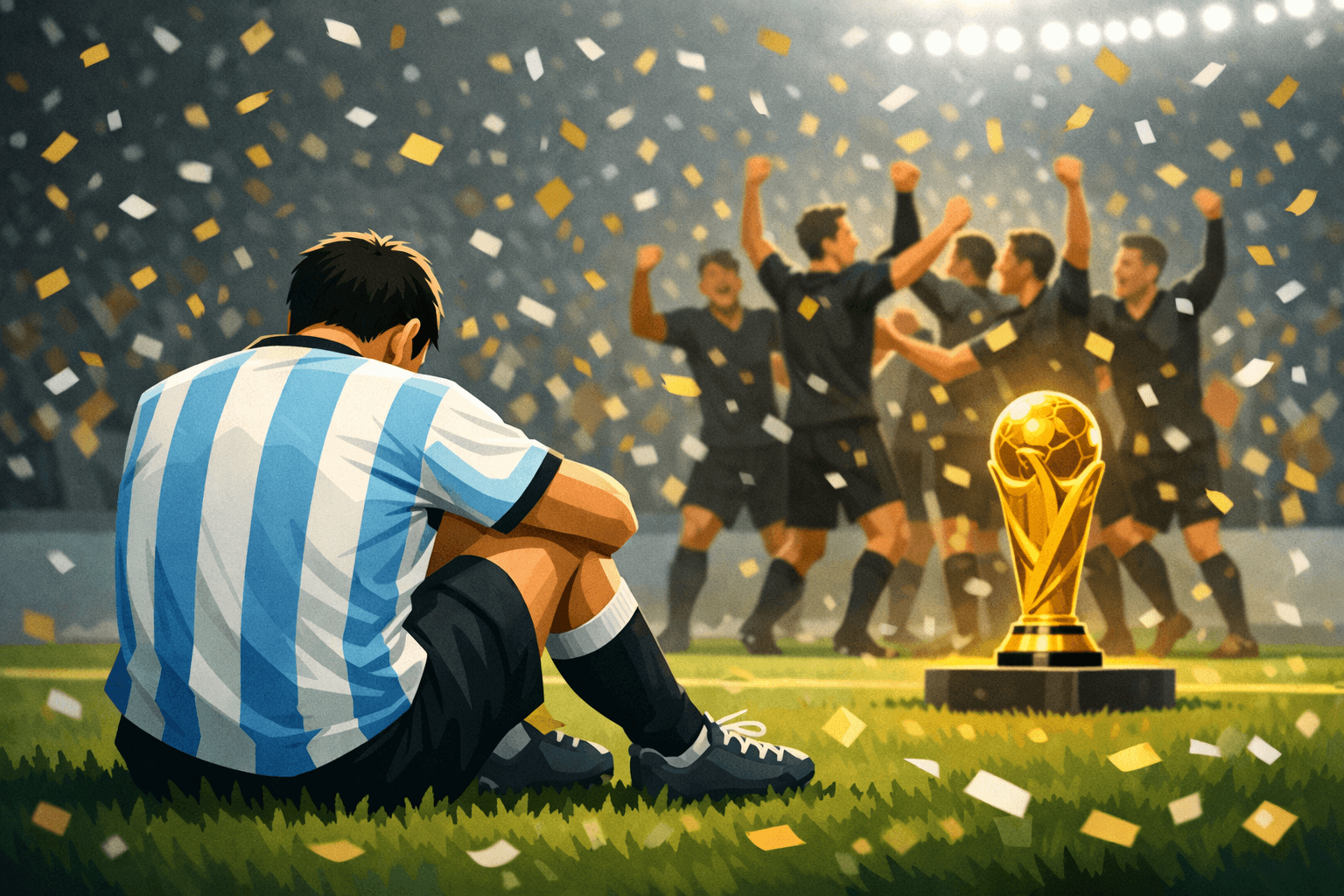
Brazil 2014 was the first World Cup in which Messi, in a clearly central role, took Argentina within touching distance of the title. He scored against Bosnia and Herzegovina, Iran and Nigeria in the group stage.
Argentina beat Switzerland in the round of 16 through Ángel Di María's late goal after an attack initiated by Messi. They then overcame Belgium and the Netherlands; in the semi-final, Sergio Romero saved two penalties.
The final at the Maracanã on 13 July 2014 was tightly contested. Neither team scored in 90 minutes before Mario Götze struck in extra time to give Germany a 1–0 victory.
Messi received the tournament's Golden Ball, but the individual award could not replace the trophy Argentina had missed out on. It was one of the most consequential defeats in his World Cup story.
2018: Argentina eliminated by France
Argentina's 2018 World Cup in Russia began badly. The team drew with Iceland, lost 3–0 to Croatia and advanced after beating Nigeria in the final group-stage match.
In the round of 16, Argentina faced France in a seven-goal match. Messi assisted Gabriel Mercado and Sergio Agüero, but France won 4–3 through their rapid transitions and Kylian Mbappé's outstanding performance.
The defeat showed that Argentina still relied heavily on individual moments. Messi could create chances, but the team lacked the consistency to control a match against a young, energetic opponent.
2022: From the shock against Saudi Arabia to the title
Argentina adjusted after the opening match
Argentina began Qatar 2022 with a 2–1 defeat by Saudi Arabia. They then beat Mexico 2–0, with Messi scoring, before defeating Poland to finish top of the group.
Unlike in some previous tournaments, Messi no longer had to create every opportunity himself. He remained the creative hub, but was supported by a more balanced team: Enzo Fernández, Alexis Mac Allister and Rodrigo De Paul made the midfield more effective; Julián Álvarez provided depth; and Emiliano Martínez brought security in goal.
Messi made his mark in every knockout round
- Round of 16: Messi scored in the 2–1 victory over Australia.
- Quarter-finals: He scored from the penalty spot and assisted Nahuel Molina in the 2–2 draw with the Netherlands; Argentina won the shootout.
- Semi-final: Messi scored and assisted Julián Álvarez in the 3–0 victory over Croatia.
- Final: Messi scored twice in the 3–3 draw with France after 120 minutes and converted his penalty in the shootout.
FIFA recorded Messi as finishing Qatar 2022 with seven goals and three assists, winning the Golden Ball and becoming the first player to receive the award twice at the World Cup. He scored or assisted in every knockout round, including twice in the final (according to fifa.com).
The final against France settled the 2014 score
Argentina led France 2–0 at half-time through Messi's penalty and Di María's goal. Mbappé scored twice in quick succession late in the second half to send the match into extra time.
Messi scored his second goal in the 108th minute, but Mbappé completed his hat-trick with a penalty in the 118th minute. Argentina won the shootout 4–2 after Gonzalo Montiel converted the decisive kick.
The moment Messi lifted the trophy on 18 December 2022 put to rest the question that had persisted for years: could he win the World Cup with Argentina?
2026: Back in the final but unable to defend the title
The 2026 World Cup was Messi’s sixth appearance at the tournament. He continued to serve as captain during Argentina’s title defense.
In the group stage, Messi scored a hat-trick in a 3–0 victory over Algeria. Statistics and records related to the match should be read alongside FIFA’s official report, because World Cup scoring records depend on the statistical criteria used (according to fifa.com).
Argentina then defeated Cabo Verde 3–2 after extra time, overcame Egypt 3–2, beat Switzerland 3–1 after extra time and defeated England 2–1 in the semi-final. Messi provided two assists for Enzo Fernández and Lautaro Martínez in the semi-final (according to fifa.com).
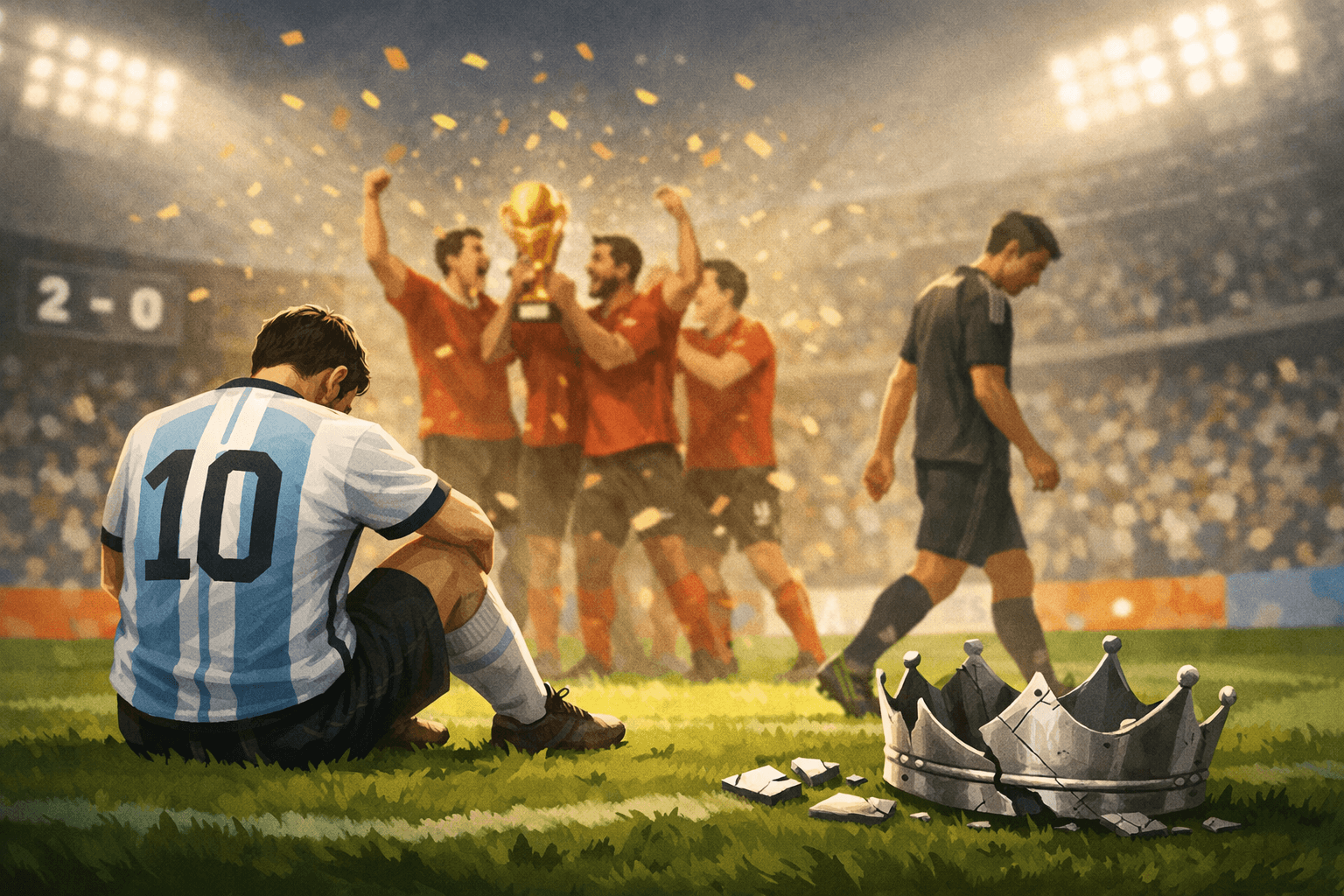
The final, played on 19 July 2026 at New York New Jersey Stadium, was Messi’s third World Cup final appearance, following those in 2014 and 2022. Argentina lost 1–0 to Spain after extra time, with Ferran Torres scoring in the 106th minute.
The result left Argentina as runners-up. Messi finished the tournament with 34 World Cup appearances, but this article does not describe it as an announcement of his international retirement unless there is a corresponding official statement (according to fifa.com).
Why is this journey so significant?
How Messi’s role changed over time
In the early tournaments, the question was often how far Messi could take Argentina on his own. By 2022, he was still the decisive figure, but he was playing within a team that had greater structure, energy and support. The change involved both Messi himself and the tactical environment around him.
The 2022 title does not erase the earlier defeats
Defeats by Germany in 2014 and France in 2018 help explain why the Qatar title carried such significance. Argentina did not merely win a tournament; the team also overcame the memory of repeatedly coming close and falling short.
The 2026 final does not diminish the achievement of 2022
The two tournaments answer different questions. In 2022, Messi achieved his goal of winning the World Cup. In 2026, he returned to the final but could not claim another title. Therefore, the 2026 result does not make the 2022 triumph any less complete.
If you want to follow more about how Messi was honored after his international career, you can read the article about Argentina’s tribute appearance for Messi.
Conclusion: How did Messi’s World Cup journey end?
Messi passed through four defining roles: the prodigy who debuted in 2006, the star under pressure in 2010 and 2014, the captain who won the title in 2022, and then the former champion who returned to the final in 2026.
The 2022 World Cup was the high point of his trophy-winning career. The 2026 World Cup was the final chapter covered in this six-tournament overview, but it should not be treated as synonymous with an official retirement announcement unless Messi or the Argentina national team confirms one. The key facts include six appearances, three finals, one title, the 2022 Golden Ball and 34 World Cup appearances (according to fifa.com).
Reference source
- How Lionel Messi has evolved | FIFA Club World Cup 2025
- Messi’s journey from wonderkid to World Cup icon
- La historia de Lionel Messi en la Copa Mundial: Catar 2022
- Argentina 3-0 Algeria | Match report and highlights
- England 2-1 Argentina | Match report and highlights
- Spain 1-0 Argentina | World Cup 2026 report and highlights
- Spain complete unprecedented global double as new milestones on the pitch define historic FIFA World Cup 2026™ finale
