






The short answer: Use Posts for content that addresses individual topics, Pages for relatively stable information or resource pages, and Labels to group posts on the same topic. Add a Page or Label to the menu only after that destination actually exists and opens from a reader’s perspective.
This article is suitable if you already have editing access to a Blogger blog or are preparing a blog for practice. If you do not yet have a real post, you can use another post in place of the sample. The result is a verifiable structure, not evidence that SaibABC Blog has been created, has an address, or has readers.
By the end of this article, you will be able to:
- Distinguish Posts, Pages, and Labels on Blogger.
- Choose consistent label names for a new blog.
- Assign the post “5 Things to Prepare Before Creating a Personal Blog” to the “Start with Blogger” label, if that post actually exists.
- Create a “Learn Blogger” Page as a resource page linking to existing content.
- Verify the path from the menu to a post without turning planned content into a fake link.
The running example is SaibABC Blog, a planned illustrative project on Blogger. This name is not evidence of an address, publication status, readership, or actual traffic results.
Distinguishing Posts, Pages, and Labels
| Component | What is it used for? | Example in SaibABC Blog | Should not be used instead of |
|---|---|---|---|
| Post | Content published in chronological order that typically answers a question or guides the reader through a specific task. | “5 Things to Prepare Before Creating a Personal Blog.” | Relatively stable information such as About or Contact details. |
| Page | Stable information or a resource page with its own address. | “Learn Blogger,” About, Contact. | Automatically grouping posts by topic. |
| Label | Assigning one or more topics to a post to create a group of related posts. | “Start with Blogger,” “Content writing.” | A long tutorial or a fixed introductory page. |
Blogger can generate a URL listing posts with the same label; the Labels gadget can also display the label name, post count, and a link to the corresponding list (according to support.google.com). Therefore, Labels are suitable for grouping Posts, not for turning every piece of content into a static Page.
Posts are the primary content unit
Use a Post when you want to answer a question, explain how to perform a task, clarify a concept, or share a topic that may be expanded over time. Posts typically appear on the home page and can be grouped with Labels.
In this example, the post “5 Things to Prepare Before Creating a Personal Blog” is a Post because it focuses on a specific topic: defining goals, choosing readers, selecting a topic, preparing a blog name, and planning a writing schedule.
Pages are for stable information or resource pages
Use a Page for information that readers may need to access over time, such as About, Contact, or Privacy Policy information. You can also use a Page to create a curated resource page such as “Learn Blogger.”
Blogger manages Pages from the Pagessection; you can then select Pages to display in the Pages gadget in the blog layout (according to support.google.com).
Labels are topic groups, not folder levels
Labels help readers find related posts. A post can have multiple labels when those labels genuinely describe its content. Do not attach every keyword you can think of to a post, because the label list will become difficult to understand and maintain.
The sample post can be assigned the label Getting Started with Blogger because it covers the initial preparation stage. Add the label Content Writing only if the post actually teaches writing or content-preparation tasks; do not add it merely because the blog as a whole focuses on content.
Name your labels before creating the menu
Before assigning labels, make a short list of the content groups you expect to use. For SaibABC Blog, an example list is:
- Getting Started with Blogger
- Design and Layout
- Domain Names
- Content Writing
- SEO and Measurement
- Blog Monetization
This is a classification plan, not evidence that every label already has posts. A label with no posts should remain in your notes or content map; do not put it in the menu as though it were a finished destination.
- Use consistent wording. Use “Getting Started with Blogger” instead of calling it “Getting Started with Blogger” in one place and “Blogger for Beginners” elsewhere.
- Describe the topic, not its status. “Domain Names” is more useful than “Important Posts” or “Must Read.”
- Create only reusable labels. A label assigned to only one post usually does not form a meaningful group, unless it is a clearly planned starting point.
In the Blogger dashboard, open the post you need to edit and find the Labelsfield or option, enter the label, and save or update the post. In the Blogger Android app, multiple labels can be separated by commas; the setting’s name or location may differ in the web dashboard (according to support.google.com).
Map the content before adding the menu
Do not start by putting every proposed name in the menu. Instead, map the path readers need to follow:
Trang chủ
├── Học Blogger — Trang tổng hợp
│   └── Bài đăng: 5 việc cần chuẩn bị trước khi tạo blog cá nhân
├── Viết nội dung — điểm đến nhãn, chỉ dùng khi nhãn đã có bài
├── Giới thiệu — Trang dự kiến
└── Liên hệ — Trang dự kiến

Nhãn của bài mẫu:
└── Bắt đầu với Blogger
This map contains three types of destinations:
- The “Learn Blogger” page is a collection point that you create and organize yourself.
- The “Getting Started with Blogger” label is a topic-based group of posts.
- The sample post is specific content that readers can open and read from beginning to end.
Two destinations can lead to the same post without serving the same purpose. A collection page lets you arrange the order and explain which post is suitable for whom; a label page automatically gathers posts with the same label.
Assign a label to the sample post and check its destination
Perform this task in the Blogger dashboard using a blog that you have permission to edit.
- Open Blogger and select the correct practice blog.
- Go to Posts and open the post “5 Things to Prepare Before Creating a Personal Blog.” If this post does not exist, use another real post for practice; the post title in the project is illustrative data only.
- Find the Labelsfield or option.
- Enter exactly
Bắt đầu với Blogger. - Select Save or Update.
- Open the post as a reader and check its labels if the interface displays post labels.
The required result is a post with the correct label. Seeing the label in the dashboard is not enough; open the label destination from the public blog and confirm that the list contains the post you just labeled.
If no real URL exists, write [địa chỉ Blogspot thực hành] in your documentation. Do not turn this placeholder into a link.
Create the “Learn Blogger” page as a collection page
This page does not need to contain all the content from the linked posts. Its purpose is to explain where readers should start and direct them to posts that actually exist.
You can start with the following draft:
Học Blogger

Khu vực này tổng hợp các hướng dẫn dành cho người mới bắt đầu xây dựng blog trên Blogger.

Bắt đầu từ đâu?
Đọc bài “5 việc cần chuẩn bị trước khi tạo blog cá nhân” để xác định mục tiêu, người đọc, chủ đề, tên blog và lịch viết dự kiến.

Sau đó, tiếp tục với các bài hướng dẫn đã được xuất bản trong danh sách bên dưới.
In the actual version, add links to published posts using titles that clearly describe their destinations. Do not link to posts that exist only in the plan.
- In Blogger, select the correct blog.
- In the left-hand menu, select Pages.
- Select New Page.
- Enter the title Learn Blogger.
- Paste the hub page content and insert links to published posts.
- Select Save to save it as a draft, or Publish it after checking it.
After publishing, open the Page URL from the reader’s perspective. Check the title, introduction, and every link on the Page. Mark it complete only when each link opens the correct post rather than a placeholder URL.
Distinguish a hub page from a label page
| Criterion | “Learn Blogger” page | “Getting Started with Blogger” label page |
|---|---|---|
| How it is created | You write the introduction yourself and choose the order of the links. | Blogger lists the posts assigned the corresponding label. |
| Purpose | Guide readers to a suitable starting point. | Group posts covering the same topic. |
| Level of control | Higher: you decide the content, introductory text, and links. | Depends on which posts carry the label. |
| When to use it | When you need a learning path or a guided collection of resources. | When you already have posts on the same topic and want readers to continue exploring. |
| Common risk | Links point to posts that do not exist or to incorrect URLs. | The label is too broad, has multiple variants, or has no posts. |
“Learn Blogger” can introduce the sample post first and then direct readers to subsequent posts as they are published. By contrast, the “Getting Started with Blogger” label should represent only posts that have been assigned the correct label.
Put only real destinations in the menu
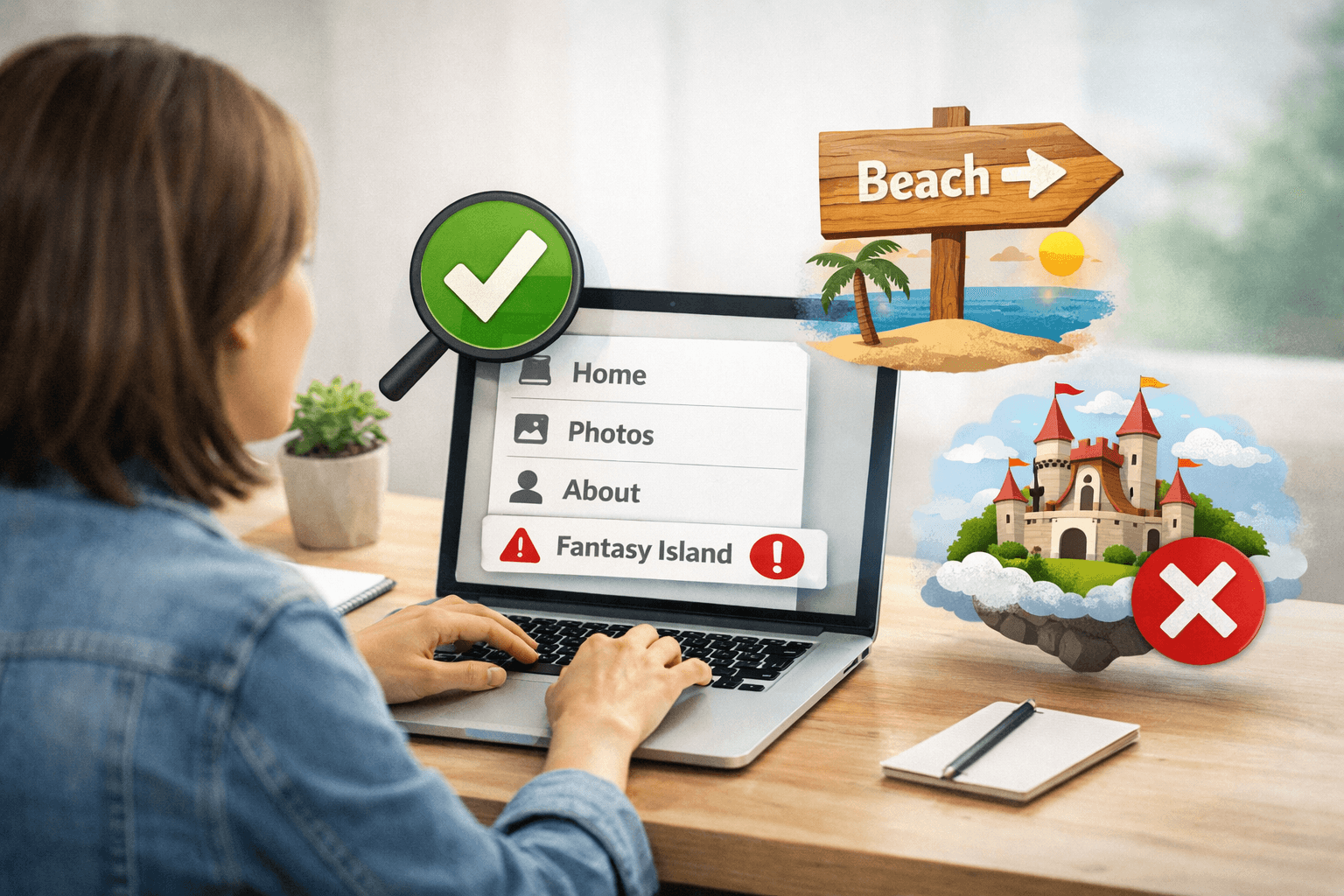
The planned complete menu for SaibABC Blog includes:
- Home
- Learn Blogger
- Writing Content
- About
- Contact
However, not every item may be ready yet. Apply the following conditions:
- Add Learn Blogger after the hub page has been created and published.
- Add Writing Content after the corresponding label has posts and its URL opens successfully.
- Add About and Contact after those Pages contain real content.
- Do not use
[địa chỉ Blogspot thực hành]as a menu URL.
In Blogger, open Layout and use the Pages or Labels gadget to select destinations, arrange their position, or add a link item by entering its name and URL. Save the layout after making changes, then open each URL from outside the admin interface. A smaller menu that works correctly is better than a complete list of empty destinations.
Checking the path from the menu to a post
Do not check only while signed in to the admin account. Follow these steps:
- Open the blog’s public URL in a private window or a browser where you are not signed in.
- From the home page, select Learn Blogger.
- On the hub page, open the link to the post “5 Things to Prepare Before Creating a Personal Blog”.
- Check that the post opens with the correct title and content.
- Return to the home page and open the “Getting Started with Blogger” label if you have added the label to a gadget or link.
- Check that the label’s post list contains the sample post.
- On a phone, tap each menu item and link; note any item that opens the wrong page, is difficult to tap, or leads to an empty page.
The path is working when readers can follow this sequence:
Trang chủ → Học Blogger → Bài đăng mẫuIf you use a label:
Trang chủ hoặc tiện ích Nhãn → Bắt đầu với Blogger → Bài đăng mẫuA label that has not been assigned to any post is not yet a content destination to promote in the menu. If it has no posts, leave it in the plan and clearly record its status instead of creating an empty link.
Common problems and how to fix them
| Symptom | Possible cause | Safe fix |
|---|---|---|
| The “Learn Blogger” page opens, but the post link is broken. | The post URL was entered incorrectly, or the post has not been published. | Open the post from the Posts list, copy its correct public URL, and then update the link on the page. |
| The menu contains a “Writing Content” item, but the label page is empty. | The label exists only in the plan, or no posts have been assigned to it. | Temporarily remove the item from the menu, or wait until an actual post is available. |
| Posts have nearly identical labels. | The labels were entered inconsistently, such as “Start Blogger” and “Getting Started with Blogger.” | Choose one standard name, review each post, and remove the variant labels. |
| The administrator can open it, but other people cannot. | The blog or post has restricted viewing permissions. | Open the URL in a private window and check the viewing permissions before concluding that the link is broken. |
| The menu has too many items. | The same row contains labels, planned Pages, and secondary links. | Keep the primary destinations; move the additional list to the hub page or a suitable gadget. |
Exercise: Build the initial structure
Create a four-column table and fill it in according to the blog’s actual status:
| Content name | Type | Status | Verification point |
|---|---|---|---|
| 5 Things to Prepare Before Creating a Personal Blog | Post | Available / not available | Post URL opens |
| Getting Started with Blogger | Label | Assigned / not assigned | Label list contains the correct post |
| Learn Blogger | Hub page | Published / draft / planned | Link to the post opens correctly |
| Writing Content | Label or menu item | Planned if no posts exist | Add it to the menu only when a real URL exists |
Do not mark something as “available” merely because it appears in the SaibABC Blog plan. Record its status based on what you actually see when you open the URL.
Completion checklist
- I can distinguish between Posts, Pages, and Labels.
- I have chosen a consistent naming convention for labels.
- The sample post has been assigned the “Getting Started with Blogger” label, if the post actually exists.
- The “Learn Blogger” page links only to content that already exists.
- I can distinguish a hub page from a label archive.
- The menu contains no placeholder URLs or nonexistent destinations.
- I have followed the path from the menu to the post in a logged-out window.
- I have tested it at least once on a phone.
Next step
Once the structure of Posts, Pages, and Labels is clear, you can add informational Pages such as About, Contact, and Privacy Policy. These Pages should reflect accurate information about the blog and the person responsible for it; do not place unverified placeholder content in the menu as if it were complete.
In this series, the next step is to prepare those informational Pages: Create About, Contact, and Privacy Policy Pages for Your Blog
Reference source
- Add pages to your blog — Blogger Help.
- Layouts Data Tags — Blogger Help.
- Use the Blogger mobile app on Android — Blogger Help.
- Change the design of your blog — Blogger Help.
