






Autonomous health with wearables does not mean diagnosing yourself based on a number from a watch or app. A safer approach is to treat wearables, home-monitoring devices, and AI as tools for tracking trends, preparing questions for your doctor, and recognizing when professional evaluation is needed.
Wearables can be useful for tracking heart rate, activity, sleep, or abnormality alerts under certain conditions. However, accuracy varies by device, wearing position, movement, skin tone, health status, and algorithm. Even an irregular heart rhythm alert is not a final diagnosis; users still need to consult a healthcare professional and undergo appropriate testing (according to FDA).
What questions should you start with when using wearables for autonomous health management?
Before buying a device or opening a healthcare AI app, identify what problem you want to solve. A clear goal helps prevent collecting too much data without knowing what to do next.
- Habit tracking: steps, activity time, sleep duration, and time spent sitting for long periods.
- Tracking a metric recommended by your doctor: such as blood pressure or blood glucose using a suitable device.
- Recording symptoms: when palpitations, dizziness, shortness of breath, headaches, or fatigue occur, to compare them with activity and sleep.
- Preparing data for a medical appointment: instead of simply saying “I don’t feel right,” you can provide when, how often, and under what circumstances the symptoms occur.
The practical principle is: measure to answer a specific health question, not simply because the app offers another chart. Data is valuable only when collected consistently and connected with symptoms, medications, sleep, activity, or other relevant factors.
Are wearables reliable? Understanding the limitations of each metric
The short answer is: they may be reliable for some purposes, but not equally reliable for every metric. Metrics used to track trends are generally more useful than a single measurement used to confirm a disease.
| Metric | Can be used for | Limitations to remember | How to verify |
|---|---|---|---|
| Heart rate | Observing resting heart rate or changes during activity | Easily affected by movement, a loose strap, caffeine, and stress | Measure again while sitting still; compare with symptoms and a medical device when needed |
| Irregular heart rhythm | Receiving an alert to seek further evaluation | Does not detect every disorder, and the absence of an alert does not rule out disease | Contact a healthcare facility if alerts recur or symptoms occur |
| Sleep | Identifying irregular sleep schedules and changes in sleep duration | Sleep stages are only estimates based on sensors and algorithms | Also record how you feel upon waking, as well as bedtime and wake time |
| SpO₂ | Using trends as a reference under stable measurement conditions | May be inaccurate due to cold hands, movement, nail polish, poor circulation, or the sensor | Measure again with a suitable device; do not ignore shortness of breath or bluish discoloration |
| Blood pressure | Tracking only when using a suitably validated monitor | Cuffless measurement features on some wearables should not automatically be treated as medical readings | Use a validated automatic upper-arm monitor |
In particular, you should not use a smartwatch or smart ring instead of a validated upper-arm blood pressure monitor. The U.S. Food and Drug Administration warns against using unauthorized devices or features to measure blood pressure when care decisions depend on the accuracy of the results (according to FDA).
For home blood pressure monitoring, the American Heart Association recommends an automatic upper-arm monitor, a correctly sized cuff, and a validated device. You should rest quietly for at least 5 minutes and avoid caffeine, smoking, and exercise for 30 minutes before measuring; take two readings each time, about one minute apart (according to heart.org).
How can you safely interpret smartwatch data and use AI?
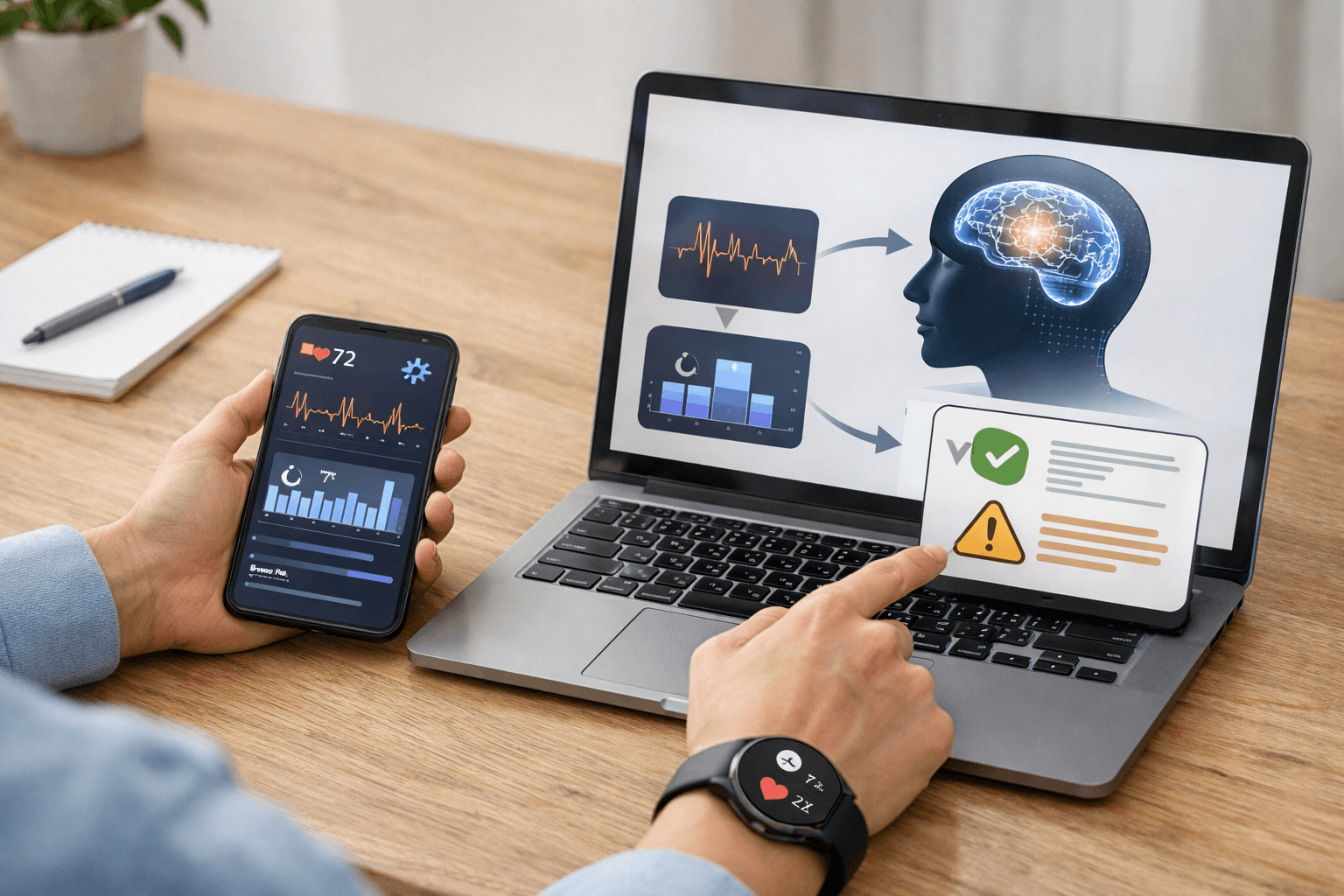
Read trends rather than drawing conclusions from a single measurement
One poor night of sleep or one instance of an elevated heart rate is not enough to conclude that you have a disease. Review the data over several days, prioritize recurring changes, and note the context. For example, an increase in resting heart rate over several days may be related to lack of sleep, fever, dehydration, stress, alcohol, or strenuous exercise; a wearable cannot determine the cause on its own.
Instead of asking “What disease do I have?”, reframe the question into verifiable ones:
- On what day did the metric change, and by how much compared with my usual level?
- Is the change accompanied by specific symptoms?
- Have I changed my medication, sleep schedule, activity level, diet, or use of stimulants?
- Is it necessary to repeat the measurement using another medical device?
AI is an explanatory tool, not an online doctor
AI can help you organize your log, summarize trends, or suggest questions for your appointment. You can ask AI to create a table including measurement date, time, symptoms, medications, and circumstances, but you should not give AI the authority to diagnose conditions, change medication dosages, or advise delaying emergency care.
AI can generate answers that sound reasonable but are incorrect, reflect data bias, or handle health information unsafely. The World Health Organization recommends caution, transparency, professional oversight, and protection of autonomy and privacy when using AI in healthcare (according to who.int).
Do not enter personally identifying information, images of medical records, national ID numbers, insurance information, or other people's data into public AI tools unless you clearly understand their data storage and usage policies.
A validated process for monitoring health at home
- Define your goal: choose no more than one or two indicators directly related to the issue you are concerned about.
- Choose the right device for its role: use a wearable for trends; use a validated medical device for indicators requiring high accuracy.
- Standardize the measurement method: measure at the same time, in the same position and at the same location, and record factors that could cause interference.
- Record symptoms as well: measurements without context are often difficult to interpret.
- Cross-check: when you notice an abnormal result, rest and measure again, then verify it with a suitable device instead of immediately drawing conclusions.
- Share the data with your doctor: send a summary table, not just a screenshot of a chart. Ask which data are useful for the next decision.
For example, if your watch repeatedly reports a resting heart rate higher than usual on three mornings and you also experience palpitations, record the time, sleep quality, caffeine intake, medications, and symptoms. Then contact a healthcare facility for advice. Do not take heart-rate-lowering medication on your own just because of an alert in an app.
If you have chest pain, severe shortness of breath, fainting, weakness or paralysis on one side, confusion, difficulty speaking, or symptoms that are worsening rapidly, call emergency services at your local number. In an emergency, do not wait for AI to analyze the situation or for your wearable to collect more data.
For issues requiring care at home, you can also refer to home care materials to create a clearer monitoring checklist.
Conclusion: self-directed health management with wearables is most effective when you use technology to observe, record, and communicate better with healthcare professionals. Trust trends viewed in context, verify important measurements with suitable devices, and always leave diagnostic and treatment decisions to qualified professionals.
Reference source
